Is SEO dead now with AI?
No. Useful, crawlable, indexable content and core SEO still matter in AI search. Here’s what changes with AI features and how to investigate real first‑party data.
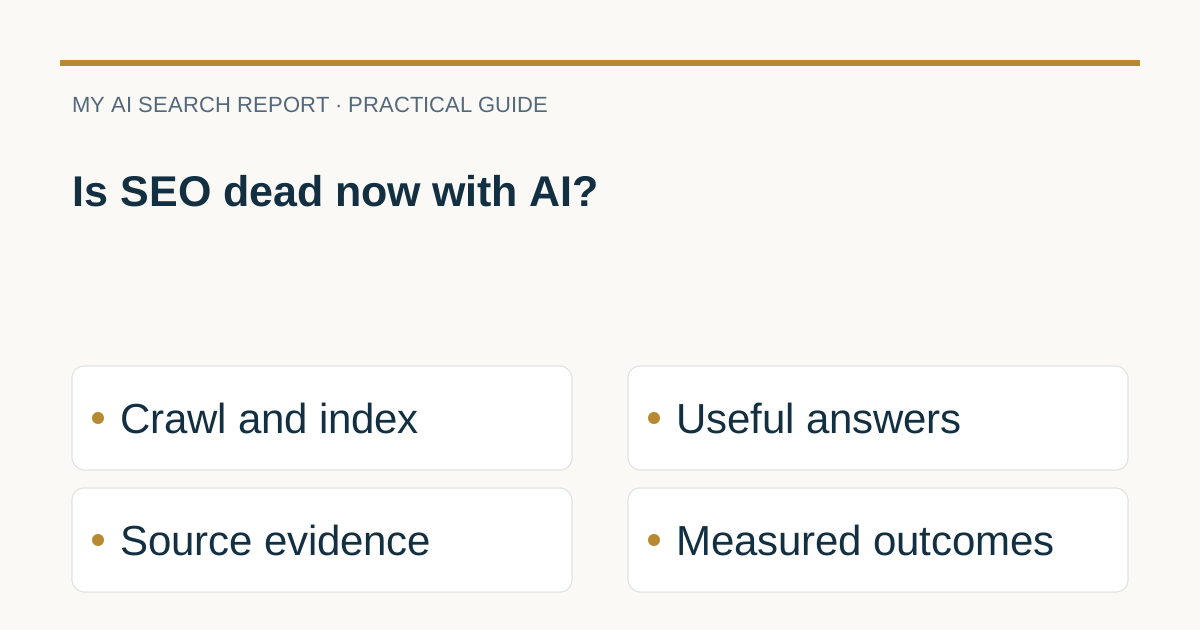
No. SEO is not dead. Google states its AI features in Search surface links from the open web and rely on the same foundational SEO practices: your pages must be crawlable, indexable and eligible for a snippet to appear as supporting links in AI Overviews or AI Mode. There are no extra technical requirements beyond normal Search eligibility and best practices like helpful, reliable, people-first content and solid site hygiene (Google: AI features and your website).
What AI changed, and what didn’t
What changed:
- More synthesis on the page: AI Overviews and AI Mode use techniques like query fan-out to explore related subtopics and identify more supporting pages, then show a diverse set of links with the response (Google: AI features and your website).
- When AI features appear: Google shows AI Overviews only when it determines they add value beyond classic results; they won’t trigger on every query (Google: AI features and your website).
What didn’t change:
- Eligibility: To be shown as a supporting link in AI features, your page must be indexed and eligible for a snippet; standard Search technical requirements apply (Google: AI features and your website).
- Core SEO: Allow crawling (robots.txt and any CDN/host controls), use internal links so content is findable, provide important content in text, deliver a good page experience, and keep Business Profile and Merchant Center data accurate when relevant (Google: AI features and your website).
- Structured data helps understanding and eligibility for rich results: Use supported formats (JSON-LD recommended), follow guidelines, and validate with Rich Results Test (Google: Intro to structured data markup).
Readiness vs observed citations
Readiness means your content meets the prerequisites: crawlable, indexable, snippet-eligible, clearly written, and well-structured. That makes it eligible to be considered for AI features. Observation means you actually see your pages linked in AI answers or notice downstream visits. Eligibility does not guarantee a citation or traffic. Treat them separately in your planning and reporting. For a practical approach, see our AI search readiness checklist.
How to investigate with your first‑party data
Google Search Console (GSC) aggregates clicks and impressions from AI features into overall Web Search performance; there isn’t a separate AI Overviews breakdown. Use GSC to analyze changes and combine it with Analytics to assess onsite engagement and conversions (Google: AI features and your website).
- In GSC Performance (Web), compare time periods before/after major content updates or eligibility fixes. Segment by page and query to see which sections benefit or lag.
- Combine with Analytics to evaluate conversion rate and time on site from search clicks, as Google notes clicks from pages with AI Overviews can be higher quality for some users (Google: AI features and your website).
- Use an audit framework to track eligibility signals and evidence. Our ten‑question AI visibility audit shows how to gather proof without promising citations.
Practical steps to stay visible in AI and classic search
1) Keep pages crawlable, indexable and snippet‑eligible
- Allow Googlebot in robots.txt and ensure any CDN or WAF doesn’t block it.
- Avoid accidental noindex on important pages; ensure canonicalization is correct.
- Make key information available in text so systems can understand it (Google: AI features and your website).
2) Strengthen information architecture
- Use internal links so topical clusters are easily discoverable by crawlers and people (Google: AI features and your website).
3) Add accurate structured data where applicable
- Prefer JSON-LD; follow the feature‑specific guidelines; validate with the Rich Results Test; eligibility is not a guarantee of enhanced display (Google: Intro to structured data markup).
4) Improve page experience and media support
- Deliver fast, stable pages and support your text with relevant images or video when it helps users (Google: AI features and your website).
5) Keep business and product data current
- Maintain your Merchant Center and Business Profile details so Search can show the right info (Google: AI features and your website).
Control and transparency
- Control previewed content in Search with
nosnippet,data-nosnippet,max-snippet, ornoindex. Crawling access is controlled via robots.txt for Googlebot (Google: AI features and your website). - To limit AI training or grounding in some other Google systems, review Google‑Extended (Google: AI features and your website).
- If you change preview controls, allow time for recrawl and processing, or request recrawl in GSC (Google: AI features and your website).
Compact checklist
- Verify the site in Search Console and fix coverage issues.
- Allow Googlebot in robots.txt and at your CDN/host.
- Ensure important pages are indexable and have clear, on‑page text.
- Use internal links to make key pages easy to find.
- Add valid JSON‑LD structured data where suitable; test with Rich Results Test.
- Provide helpful, reliable, people‑first content with strong page experience.
- Keep Business Profile and Merchant Center data up to date if relevant.
- Measure in GSC (Web) and Analytics; annotate major changes; compare by page/query.
- Differentiate eligibility (readiness) from observed citations and visits; don’t assume one implies the other.
- Learn how query fan‑out changes retrieval scope: what “query fan‑out” means.
FAQ
Is there special markup for AI Overviews?
No. Google says there are no additional technical requirements. Pages must simply meet normal Search requirements and be indexable with snippet eligibility (Google: AI features and your website).
Can I stop my content from appearing in AI features?
Crawling is controlled via robots.txt for Googlebot. You can limit what’s shown in Search using nosnippet, data-nosnippet, max-snippet, or remove a page from Search with noindex. To limit AI training/grounding in some other Google systems, review Google‑Extended. Allow time for recrawl after changes (Google: AI features and your website).
How can I tell if traffic came from an AI Overview?
Google reports AI features within overall Web Search in Search Console and does not provide a separate AI Overview breakdown. Combine GSC with Analytics to assess engagement and conversions (Google: AI features and your website).
For broader context on how AI search differs from classic Google results, see key differences between Google search and AI search.
Put this into practice
Choose one existing page with a clear user task and compare its actual search and referral evidence over a defined period. Keep technical accessibility, search impressions and observed answer citations as separate measurements.
Sources and further reading
Provider documentation can change. Check the current guidance before changing crawler or search settings.