What is ground truth in the context of AI?
Ground truth is the set of reference labels or values treated as correct for training and evaluating AI models. It can be direct or proxy, and it is vulnerable to incompleteness, bias and error. Here’s what it is, how it differs from grounding in evidence and objective truth, and a practical way to define, review and version your labels.
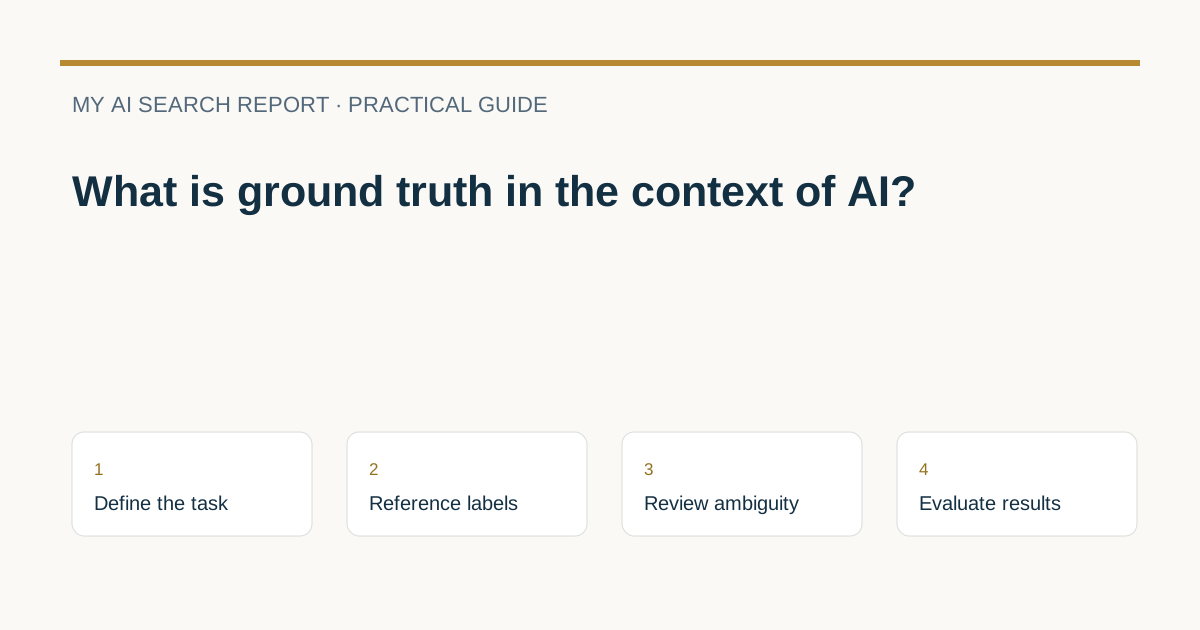
Ground truth in AI is the set of reference labels or values that a model treats as correct for a task. In supervised learning, models can learn from reference labels during training and be evaluated against a separate labeled dataset. Ground truth may be a direct label that exactly matches the target, or a proxy that approximates it when the exact label is unavailable, and all such labels can be incomplete, biased or erroneous if not carefully defined and reviewed (Datasets: Labels; Data quality and interpretation).
What counts as ground truth?
Two common cases:
- Direct labels: The label is exactly the thing you want to predict. If your goal is to predict whether a person owns a bicycle, a column labeled “bicycle owner” would be a direct label (Datasets: Labels).
- Proxy labels: A similar but not identical signal used when direct labels do not exist. For the bicycle example, “recently bought a bicycle” might be a useful but imperfect proxy, because people sometimes buy bikes as gifts. Proxies are only as useful as their connection to the true target, so they require scrutiny (Datasets: Labels).
Ground truth can be human-generated (raters apply criteria) or automated (instruments or other models produce labels). Human labels can capture nuance but are costly and error-prone, so quality control and spot-checks against clear criteria are essential. Mixing human and automated labels can work, but added maintenance may outweigh benefits unless the human labels add unique signal (Datasets: Labels).
Example: hypothetical relevance labels for search
Suppose you’re evaluating a search model for the query “best commuter bike locks.” You create a 0-3 relevance scale:
- 3: Directly answers the query with up-to-date picks for commuter bike locks
- 2: Helpful but incomplete (e.g., reviews without commuter focus)
- 1: Tangential (e.g., general bike security tips with few lock details)
- 0: Irrelevant
You write guidelines with examples, double-rate each result, and adjudicate disagreements. Even then, pitfalls remain:
- Sampling bias: If you only label English pages or a single region, you may overfit to that slice of the web (Data quality and interpretation).
- Rater variance and ambiguity: Reasonable people can disagree about borderline cases; ambiguous criteria make this worse (Data quality and interpretation).
- Proxy misuse: Using clicks or dwell time as a proxy for relevance can import confounders like position bias or presentation effects (Data quality and interpretation).
- Noise and small N: With few labeled queries, chance variation can dominate your conclusions (Data quality and interpretation).
Ground truth vs grounding vs objective truth
| Term | What it means | Typical artifacts |
|---|---|---|
| Ground truth | Task-specific reference labels used to train or evaluate a model | Label guidelines, rater decisions, gold/test sets |
| Grounding | Generating an answer with cited, retrieved evidence so users can verify sources | Retrieved passages, citations, attribution; see our RAG explainer and AI citation accuracy |
| Objective truth | Universal, real-world fact independent of task framing | Outside the label set; labels approximate it and can deviate due to bias, errors, or ambiguity (Data quality and interpretation) |
A practical process for defining, reviewing and versioning labels
1) Define the target and choose labels
- Write the exact prediction target, scope, and use cases.
- Prefer direct labels. If you must use proxies, document why they are appropriate and the risks (Datasets: Labels).
2) Draft clear guidelines
- Define classes or scales with decision rules, examples and counter-examples.
- State tie-breakers and a “cannot determine” option for unclear items.
3) Recruit and train raters
- Specify needed skills, sample size, timelines and budget; train with calibration tasks (Datasets: Labels).
4) Pilot, measure agreement, adjust
- Double-rate or triple-rate a pilot batch.
- Review disagreements, refine definitions, retrain where needed.
5) Quality checks and bias reviews
- Randomly inspect items by hand, compare against guidelines and known “gold” examples (Datasets: Labels).
- Probe for data-reality gaps, sampling biases (survivorship, self-selection, recall), and label dirt (misspellings, wrong units, missing values) (Data quality and interpretation).
- Check class balance and avoid leakage from target variables into features.
6) Versioning and governance
- Freeze test sets; assign dataset and guideline versions with dated changelogs.
- Record label schema, rater pools, instructions and adjudication notes.
- Store lineage: data sources, sampling methods and any proxy rationales.
7) Maintenance
- Monitor drift; periodically re-annotate samples to see if definitions still hold.
- Re-evaluate proxies to ensure they continue to correlate with the true target (Datasets: Labels).
Actionable checklist
- Write the exact target and decide direct vs proxy label, with justification.
- Publish a v1.0 guideline with examples and a “cannot determine” option.
- Choose a pilot appropriate to the task and available resources; use independent ratings on a shared subset to identify disagreements.
- Choose spot-check coverage according to the task, label uncertainty and consequences of error; log issues and fixes.
- Document sampling method and known biases; adjust sampling if needed.
- Freeze a test set; version everything (data, schema, guidelines, raters).
- Review labels and proxy assumptions when the task, source data or labeling criteria change.
FAQs
Is ground truth always objective?
No. Human raters can reasonably disagree, instruments fail, and data can diverge from reality; this data-reality gap means labels approximate truth rather than guarantee it (Data quality and interpretation).
Can user clicks be used as ground truth?
Sometimes as a proxy, but clicks embed biases like position and presentation, so treat them as indirect signals and validate their connection to the true target (Data quality and interpretation; Datasets: Labels).
How much labeled data do I need?
It depends on task complexity and noise. Small datasets are prone to random fluctuations and misleading effects, so be cautious when interpreting results on low-N samples (Data quality and interpretation).
Related guides
Sources and further reading
Provider documentation can change. Check the current guidance before changing crawler or search settings.