What does AI share of voice mean?
AI share of voice is a sampling-based metric of how often AI answers mention or cite your brand within a defined test. Here’s how to define scope, separate mention and citation signals, and calculate a reproducible result with a hypothetical 3/10 example.
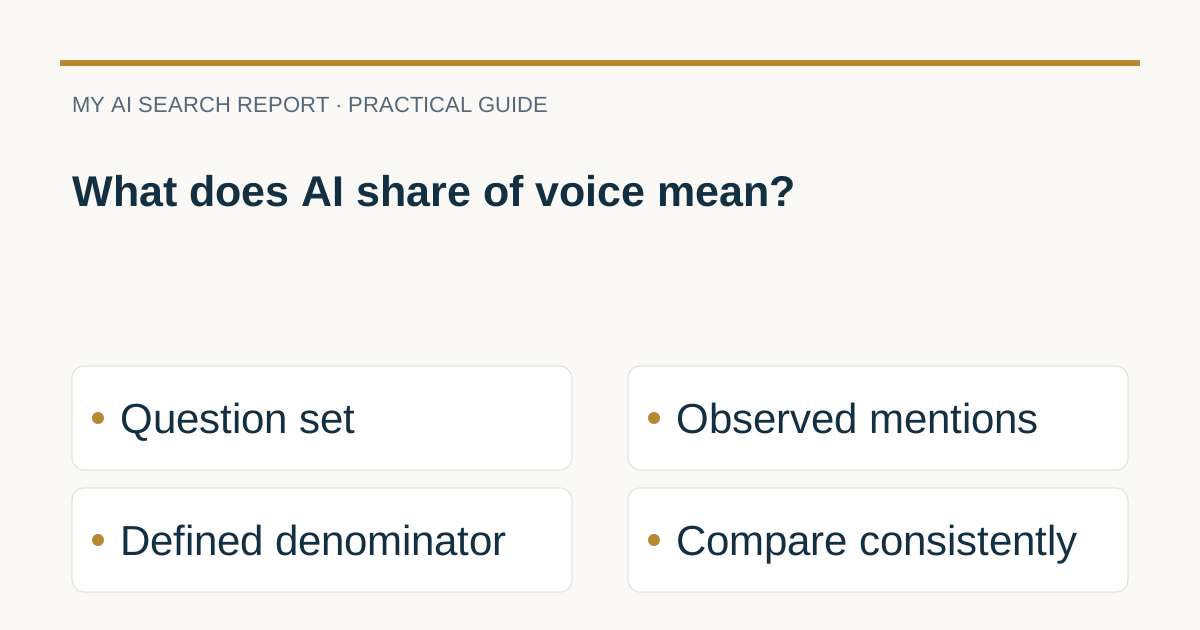
AI share of voice is a sampling-based measure of how often an AI answer mentions or cites your brand within a strictly defined test. It is not a universal market-share metric. To make it reproducible you must fix the prompt set, engines and modes, language and locale, date window, number of runs, and the competitor universe. Then report separate metrics for mention rate, citation rate and mention share.
A practical definition you can reproduce
Define one test scope and keep it fixed for the whole run:
- Prompts: A fixed list of questions (for example 50 buyer and comparison queries). No substitutions after the run starts.
- Engines and modes: Name the exact systems and settings you will test (for example, Google AI Overviews or AI Mode; Perplexity Pro Search). Google’s AI features surface supporting links to help exploration and may use query fan-out to issue multiple related searches that expand link coverage (Google Search Central on AI features). Perplexity’s Pro Search compiles from many sources and includes direct links to originals (Perplexity: What is Pro Search?).
- Language and locale: Lock country, language and interface locale.
- Date window: Run within a clearly stated time range and record the timestamps.
- Runs: Decide how many independent runs per prompt-per engine (for example, 3) to reduce answer variability.
- Competitor universe: A named list of brands and domains you will count as peers.
- Counting rules: Define what counts as a brand mention (textual reference) vs a citation (a linked supporting source to your domain). Note that not every AI surface exposes links; when links aren’t shown, only mention metrics can be computed.
Eligibility notes: To be linkable in Google’s AI features, a page must be indexed and eligible for Search results snippets; there are no additional technical requirements beyond normal Search eligibility. AI features’ clicks are counted within overall Search Console web traffic, so analyze traffic there rather than in your SOV sample (Google Search Central on AI features).
Separate the signals you report
Mention rate
The percentage of answers in your test that include a textual brand reference (linked or unlinked).
Formula: mentions_of_you / total_answers_evaluated.
Citation rate
The percentage of answers that include a linked supporting source from your domain. This applies only when the engine exposes links in its AI surface (for example, Google AI features show supporting links; Perplexity Pro Search includes direct links) (Google Search Central on AI features)(Perplexity: What is Pro Search?).
Formula: answers_linking_to_your_domain / total_answers_evaluated_with_links_visible.
Mention share
Your share of brand mentions among the named competitor universe across the same test.
Formula: your_mentions / (your_mentions + competitor_A_mentions + competitor_B_mentions + ...).
Keep mention share distinct from citation rate. Mentions reflect narrative presence; citations reflect linked attribution.
A clearly labelled 3/10 hypothetical example
Scope (hypothetical):
- Prompts: 10 fixed English (US) prompts
- Engines: One engine and one mode
- Date: 31 Oct 2026, single run per prompt
- Competitors: You, Competitor A, Competitor B
Observed counts in this sample (hypothetical, for illustration only):
- Your brand mentioned in 3 of 10 answers
- A linked supporting source to your domain appears in 2 of those 10 answers (the AI surface showed links)
- Total mentions across brands: You = 3, Competitor A = 4, Competitor B = 1
Computed metrics from this sample:
- Mention rate: 3/10 = 30%
- Citation rate: 2/10 = 20%
- Mention share: 3 / (3 + 4 + 1) = 3/8 = 37.5%
This is a toy example to show the math. It is not a benchmark, ranking, or any observed network performance.
What counts as a citation and why engines differ
- Google’s AI Overviews and AI Mode surface relevant links and may expand coverage using query fan-out, which can change which sources appear across runs and time (Google Search Central on AI features).
- Perplexity’s Pro Search explicitly compiles and shows direct source links in answers (Perplexity: What is Pro Search?).
Because links vary by engine and question, always state which surfaces expose links and limit citation calculations to those cases. Track downstream traffic separately in analytics; SOV is a sampled visibility metric, not a visit metric. For the differences between mentions, citations and visits, see our short guide on AI citations vs brand mentions. To analyze visits, use your analytics tooling; here’s a practical walkthrough for seeing AI referral traffic in GA4.
Reporting and limitations
- Always include your sampling denominator: prompts × engines × runs, the date window, language/locale, and the named competitor list.
- Engines evolve and answers can change day to day. Re-run the same fixed test later to compare periods rather than mixing scopes.
- If an engine or mode does not expose links, report citation rate as “not applicable” for that slice, and avoid inferring attribution.
- Pages must be eligible for Search to be cited in Google’s AI features; there are no special AI-only technical requirements beyond standard indexing and snippet eligibility (Google Search Central on AI features).
Actionable checklist
- Write and freeze your prompt list and competitor list.
- Choose engines and precise modes; note which expose links.
- Lock language/locale and the test date window.
- Decide runs per prompt-engine and document randomization settings (if any).
- Define counting rules for mentions and for citations to your domain.
- Collect outputs, then compute: mention rate, citation rate, mention share.
- Publish results with full scope details and denominators.
- Track traffic separately in Search Console and GA4; don’t treat SOV as visits.
FAQs
Is there a universal AI share-of-voice metric?
No. Results depend on your prompts, engines, locales, dates, runs and competitor list. Always disclose scope.
What if answers change between runs?
That’s expected. Use multiple runs, keep scope fixed, and compare period-to-period using the same setup.
Can I improve citation rates with special markup?
Google’s AI features don’t require special markup beyond normal Search eligibility; they surface supporting links from indexed content. Good technical SEO and clear, verifiable content help eligibility; measure impact via traffic tools rather than your SOV sample (Google Search Central on AI features).
Put this into practice
Keep the query set, provider, date and counting rule fixed for a comparison. Report mentions and linked citations separately, with the number of completed answers, so a changing sample is not presented as a share-of-voice improvement.
For campaign data used alongside visibility observations, Orvus explains naming conventions. Consistent labels help comparison, but campaign visits and answer citations remain different measurements. UTM naming conventions that keep your analytics clean.
Sources and further reading
Provider documentation can change. Check the current guidance before changing crawler or search settings.