What are the best tools for answer engine optimization?
A practical, tool-led AEO toolkit covering owner reporting, structured data testing, crawl/access checks, neutral question testing and manual citation verification, with clear limits for what each tool can and can’t prove.
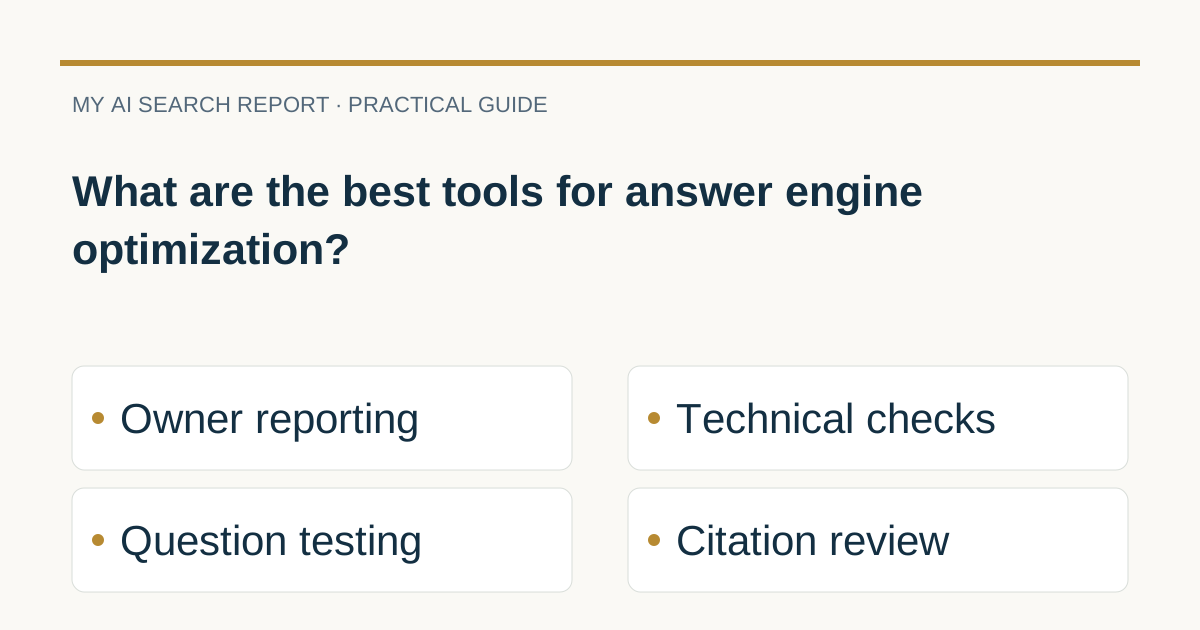
Owner reporting: measure visibility first
Google Search Console (GSC): To be eligible as a supporting link in AI Overviews or AI Mode, a page must be indexed and eligible for a snippet. Google also states that sites shown in these AI features are included in overall Search traffic in Search Console, within the “Web” search type (Google: AI features and your website).
- What it can prove: Indexed status, snippet eligibility, and aggregate clicks/impressions when surfaced in AI features (counted under Web).
- What it cannot prove: A Web total alone does not isolate an AI feature, prove a particular citation or explain why a result appeared. Record the exact report, filters, dates and coverage; keep any AI-specific report separate from overall Web totals.
Bing Webmaster Tools: Set it up alongside GSC to confirm Bing crawl/index status, sitemaps and basic performance trends. Treat it as a second source of crawl and query evidence. (No tool can promise AI citations.)
Structured data testing: eligibility, not guarantees
Structured data helps Google understand your content and can enable rich results. Google supports JSON-LD (recommended), Microdata and RDFa; use the Rich Results Test to validate markup and ensure required properties match visible content. Valid markup improves understanding and eligibility, but never forces a specific display or ranking (Google: Introduction to structured data).
- What it can prove: Your schema is syntactically valid, aligned with page text, and eligible for applicable features.
- What it cannot prove: That an AI answer or any rich result will show; selection varies by query and system behavior.
Related how-to: How to check JSON-LD before publishing.
Crawl and preview controls: who can fetch and what may show
AI is integrated into Google Search. Control access with robots.txt (Googlebot) and control what can be shown in Google Search with nosnippet, data-nosnippet, max-snippet, or noindex. Google emphasizes you must meet baseline technical requirements (indexed and snippet-eligible) to appear in AI features (Google: AI features and your website).
- What these prove: Whether bots are allowed to fetch pages, and what preview text can be displayed.
- What they cannot prove: Inclusion in AI answers; they only enable or limit eligibility and previews.
For ChatGPT web results, OpenAI says to allow OAI-Searchbot crawling and confirm your host/CDN allows traffic from its published IPs; placement is not guaranteed (OpenAI: Searching the web with ChatGPT).
- What this proves: Your site is reachable by OAI-Searchbot and thus eligible for inclusion in ChatGPT web answers.
- What it cannot prove: Appearance or ranking in responses.
Step-by-step access checks: How to verify search and AI crawler access.
Repeatable neutral question testing
Build a small, stable set of neutral, user-centric questions that don’t name your brand. Test them on a schedule across engines and modes, logging which pages and brands are cited. Google explains AI Overviews and AI Mode may use a “query fan-out” technique (issuing multiple related searches across subtopics and data sources) and may use different models and techniques, so links and responses can vary by mode and over time. AI Overviews only trigger when additive to classic Search, so they often won’t appear (Google: AI features and your website).
- What this can prove: Real-world presence and citation patterns for specific questions at a point in time.
- What it cannot prove: Persistent share of voice; results vary by mode, locale, phrasing and date.
Perplexity testing: Perplexity’s Pro Search synthesizes information from diverse, high-quality sources and includes direct links in answers. Use those links to check what the system actually used (Perplexity: Pro Search).
Manual citation validation workflow
Open every cited source from ChatGPT or Perplexity and confirm it truly supports the stated claim (and is timely). OpenAI warns search-based responses and citations can be incomplete, outdated, or incorrect; you should open cited sources to check support and recency (OpenAI: Searching the web with ChatGPT). Perplexity answers include direct links for verification (Perplexity: Pro Search).
- What this can prove: That the evidence exists at the cited URL and matches the specific claim.
- What it cannot prove: Future consistency of citations or correctness of any uncited statements in the answer.
Putting it together
Use owner reporting for aggregate reality, validators for eligibility, crawl controls for access, and repeatable tests plus manual citation checks for ground truth on key questions. Expect variability: Google notes AI Mode and AI Overviews can use different models and techniques, so link sets and triggers differ (Google: AI features and your website).
Actionable AEO checklist
- Verify indexing and previews: Confirm URLs are indexed and snippet-eligible in GSC; fix coverage issues (AI features count in Web) (Google: AI features and your website).
- Validate structured data: Run priority templates in Google’s Rich Results Test; ensure visible text matches the markup (Structured data intro).
- Harden crawler access: Allow Googlebot for public pages; use snippet controls carefully. Allow OAI-Searchbot if you want inclusion in ChatGPT web results (OpenAI web search).
- Build a 10-20 question test set: Neutral, task-led questions; fix locale/language; test on a schedule.
- Log outcomes: Record which engines show answers, the links they show, and whether your pages are cited.
- Manually verify citations: Open every cited URL and check the claim, date and source authority.
- Iterate content: Improve clarity, completeness, and on-page evidence where answers misstate or skip your page.
FAQ
Can structured data force my site into AI answers?
No. Valid schema can help understanding and eligibility, but inclusion is query- and system-dependent (Structured data intro).
How do I see if Google AI sent me traffic?
Google reports sites shown in AI features within overall Web search data in Search Console. When analysing trends, record the available report and filters precisely; do not relabel an overall Web total as AI-only traffic (AI features and your website).
Do AI citations mean the whole answer is correct?
Not necessarily. OpenAI notes citations can be incomplete or wrong; always open sources to validate support and freshness (OpenAI web search).
Put this into practice
List the decisions you need the tool to support, then ask what evidence it actually collects. Compare query coverage, linked citations and exportable records; a dashboard score alone does not prove live answer-engine visibility.
For one specific technical check within a broader tool review, CheckMySchema explains breadcrumb validation. Passing that check does not demonstrate an answer-engine citation. How to check breadcrumb schema?.
Sources and further reading
- Google: AI features and your website
- Google: Introduction to structured data
- OpenAI: Searching the web with ChatGPT
- Perplexity: Pro Search
Provider documentation can change. Check the current guidance before changing crawler or search settings.