Can Elasticsearch be used as a vector database?
Yes. Elasticsearch works as a vector database by storing embeddings in dense or sparse vector fields and running kNN similarity search, with options for hybrid keyword/vector retrieval, quantization, and managed or BYO embeddings.
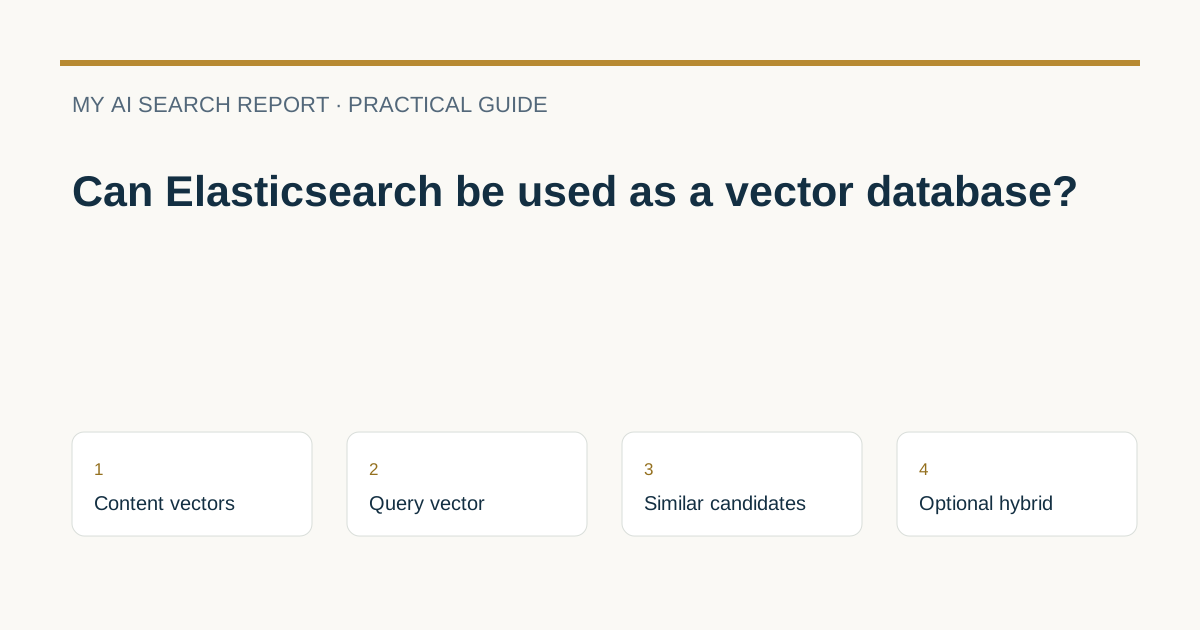
Yes. Elasticsearch can be used as a vector database. The official documentation states that Elasticsearch stores embeddings and retrieves the most similar vectors, functioning as a vector database when you index embeddings in dense_vector or sparse_vector fields and query them with kNN or related methods (Elastic vector search docs).
What “vector database” means in Elasticsearch
Elasticsearch stores numeric embeddings and finds nearest neighbors to a query embedding. It supports dense vectors from neural models and sparse vectors from learned encoders such as ELSER, and can combine vector search with full-text search, filters and aggregations in one engine (Elastic vector search docs).
- Field types:
dense_vectorandsparse_vector(plus managed workflows viasemantic_text) (Elastic vector search docs). - Queries: k-nearest neighbor (
knn) for dense vectors and a dedicated sparse vector query for sparse fields; usable via Query DSL or ES|QL (Elastic vector search docs). - Hybrid retrieval: Combine keyword, vector and reranking in one workflow, including retrievers and ES|QL FORK/FUSE with RRF or linear fusion (Elastic vector search docs).
End-to-end workflow: ingestion, embeddings, indexing and query
1) Ingest and embed your content
- Choose an embedding model. Elastic offers built-in options: ELSER for sparse vectors, E5 and Jina models for dense or multimodal use, or connect third-party services through the Inference API (Cohere, OpenAI, Hugging Face, Bedrock, Azure OpenAI, Vertex AI). Use the same model for stored vectors and query vectors so similarity is meaningful (Elastic vector search docs).
- Chunk long documents. Splitting text before embedding improves matching to specific passages. Elastic provides chunking in its managed
semantic_textflow; if you bring your own embeddings, chunk before indexing (Elastic vector search docs).
2) Index design and storage
- Pick a field type. Use
dense_vectorfor continuous embeddings andsparse_vectorfor learned, term-like sparse representations. Vector dimensionality is fixed by your model and must match between stored and query vectors (Elastic vector search docs). - Apply vector index mode. Vector-focused defaults can be enabled with index mode for vector search workloads (Elastic vector search docs):
{
  "settings": {
    "index": {
      "mode": "vectordb_document"
    }
  }
}
- Control memory and speed with quantization. Elasticsearch supports quantization for
dense_vectorfields (including BBQ, int8, and int4) to reduce memory and latency with accuracy and performance trade-offs that depend on the data and configuration (Elastic vector search docs).
3) Indexing
- Managed embeddings: The
semantic_textfield can handle embedding generation and chunking. - Bring your own vectors: Generate embeddings externally and store them directly in a
dense_vectororsparse_vectorfield (Elastic vector search docs).
4) Querying and retrieval
- Vector similarity: Use the
knnquery for dense vectors or the sparse vector query for sparse fields. You can also use ES|QL functions for nearest-neighbor and vector comparisons like cosine similarity (Elastic vector search docs). - Filters and aggregations: Combine vector search with structured filters and analytics in the same request (Elastic vector search docs).
- Hybrid and reranking: Use retrievers or ES|QL FORK/FUSE to blend keyword and vector branches, using rank fusion to combine lists and, where supported, a separate model-based reranking step for stronger relevance (Elastic vector search docs). For background, see What is BM25 keyword search? and Semantic vs hybrid search.
Exact vs approximate kNN
The docs note that vector search typically uses approximate or exact k-nearest neighbor. Elasticsearch exposes kNN search and supporting tooling; your choice balances recall and latency for your workload (Elastic vector search docs).
Optimizations that matter in production
- Quantization: Enable BBQ, int8 or int4 quantization on
dense_vectorfields to cut memory and speed up similarity computation (Elastic vector search docs). - Vector index mode: Start indexes in
vectordb_documentmode to get vector-friendly IO and merge settings without manual tuning (Elastic vector search docs). - Chunking: Map queries to the most relevant passages rather than entire documents (Elastic vector search docs).
- Hybrid retrieval: Blend lexical and semantic signals and optionally rerank. For broader application patterns like RAG, see RAG in AI applications.
Actionable checklist
- Pick an embedding model (ELSER for sparse; E5 or Jina for dense/multimodal), and keep the same model for queries and indexed vectors (Elastic vector search docs).
- Define chunking rules for long documents before embedding.
- Create an index with
index.mode: vectordb_documentand choosedense_vectororsparse_vectorfields. - Record vector dimensionality from your model and validate it at ingest and query time.
- Enable quantization on dense vectors if memory/latency is a concern.
- Query with
knn(dense) or sparse vector queries; add filters as needed. - Combine lexical and vector retrieval with retrievers or ES|QL FORK/FUSE; consider RRF or reranking.
- Measure recall vs latency; tune chunk size, k, quantization and fusion weights accordingly.
FAQs
Do I need the same model for queries and indexed vectors?
Yes. Similarity only makes sense when vectors come from the same embedding model (Elastic vector search docs).
Can I bring my own embeddings?
Yes. You can store precomputed vectors in dense_vector or sparse_vector fields and search them directly (Elastic vector search docs).
Does Elasticsearch support hybrid keyword and vector retrieval?
Yes. You can combine keyword queries, vector kNN and sparse retrieval in one workflow and merge with retrievers or ES|QL FORK/FUSE using RRF or linear fusion (Elastic vector search docs).
What about optimizing storage and speed?
Use quantization for dense vectors and consider vector index mode for better out-of-the-box performance (Elastic vector search docs).
Sources and further reading
Provider documentation can change. Check the current guidance before changing crawler or search settings.