What is the difference between semantic search and hybrid search?
Semantic search focuses on meaning; hybrid search combines retrieval methods. Learn where keyword matching, vectors, fusion and reranking fit, with a clearly scoped Azure example.
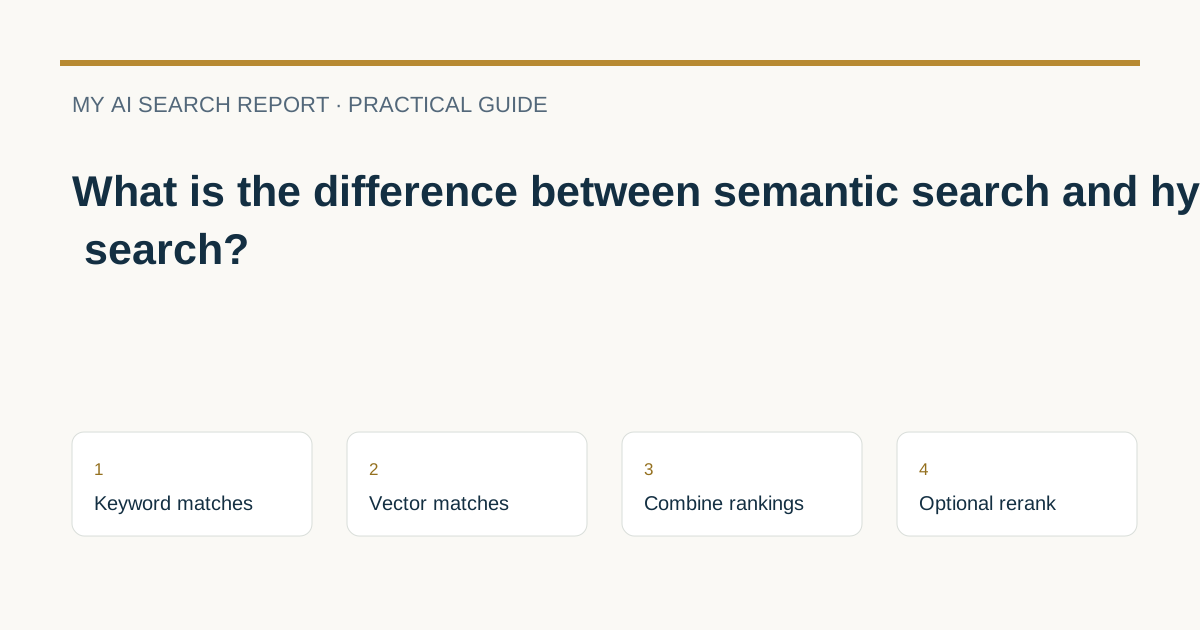
Semantic search aims to find content by meaning, rather than relying only on matching words. Hybrid search combines retrieval approaches, commonly keyword search and vector similarity search. The terms describe different choices: a system can use meaning-based retrieval as part of a hybrid search, then apply a separate reranking step. A product may also use “semantic” as the name of a particular feature, so check its documentation before treating the labels as interchangeable.
Meaning-based matching versus combining result lists
A keyword query can be useful when the exact wording matters, such as a part number or a named document. Vector search instead compares numerical representations of content and the query. Similarity can connect conceptually related wording that does not share the same terms. Microsoft gives “dog” and “canine” as an example in its vector search overview. That is one implementation of meaning-based matching, rather than a definition of every product called semantic search.
Hybrid retrieval combines approaches instead of choosing only one. In Azure AI Search's documented hybrid query, keyword and vector queries run together and their ranked lists are combined using reciprocal rank fusion. The keyword side can preserve useful exact matches while the vector side can find related concepts. Combining them does not prove that every returned document is relevant or correct.
Keep four stages distinct
| Term | What it does | What to check |
|---|---|---|
| Keyword retrieval | Finds and ranks content using matching terms. | Whether exact identifiers and important wording survive the query process. |
| Vector retrieval | Finds content with similar numerical representations. | Whether the embedding model captures the meanings your users need. |
| Hybrid retrieval | Combines candidate lists from different retrieval approaches. | How the product merges those lists and applies filters. |
| Reranking | Reorders candidates already retrieved. | Which candidates and content reach that later stage. |
The mechanics of the first three rows are illustrated in Microsoft's hybrid search overview. For background on lexical scoring, see BM25 keyword search. A retrieval system's relevance score is not a test of whether a factual statement in a document is true.
Why Azure's “semantic ranker” needs a separate explanation
Azure semantic ranker is a specific later-stage feature. It applies language-understanding models to an existing result set. It can follow keyword retrieval or a fused hybrid result set, and it works with the candidates it receives rather than searching the entire index again. The same documentation distinguishes its extracted captions and answers from generated prose.
Calling that feature semantic reranking is precise in the Azure context. Defining all semantic search as reranking would be too narrow: meaning-based retrieval and a later reranker are different parts of a pipeline. Our guide to reciprocal rank fusion versus reranking explains why merging lists and rescoring candidates can both be used.
A hypothetical example
Imagine a help centre receiving “my headphones keep dropping the connection.” Keyword search may find the exact phrase; vector search may also find an article titled “Troubleshooting intermittent Bluetooth audio.” A hybrid system can combine those candidate lists. An optional reranker can then assess which retrieved passages better address the question. This is an illustration of the stages, not an observed test result or a claim about a particular search engine.
Choose from evidence about your own queries
- List representative questions, including exact identifiers and natural-language descriptions.
- Decide what a useful result means for each question before comparing configurations.
- Check which documents each retrieval method finds and which important documents it misses.
- If you add fusion or reranking, compare the final ordering without confusing it with candidate coverage.
- Record the product, configuration and tested query set so a later comparison is meaningful.
Use the provider's documentation for configuration details. There is no universal setting implied by the words semantic or hybrid. Neither approach guarantees an AI answer citation, and this explanation does not establish how an undisclosed external search engine retrieves its sources.
Related guides
Sources and further reading
Provider documentation can change. Check the current guidance before changing crawler or search settings.