What Is an AI Agent? Read a Simple Source-Check Trace
See an AI agent decide whether to make a second lookup after its first source falls short, and learn what evidence to record.

 My AI Search Report
At a glance
An AI agent works toward a goal, takes an action and uses the result to choose what comes next. A simple trace can show how one source changes the next lookup.
In this guide
An AI agent is software that uses a goal to choose actions, observes what happens, and uses the result to decide what to do next. A source-check example makes the idea concrete. The system first reads a help page, notices that it lacks a version, and decides whether to look at release notes.
Name the task and its tools
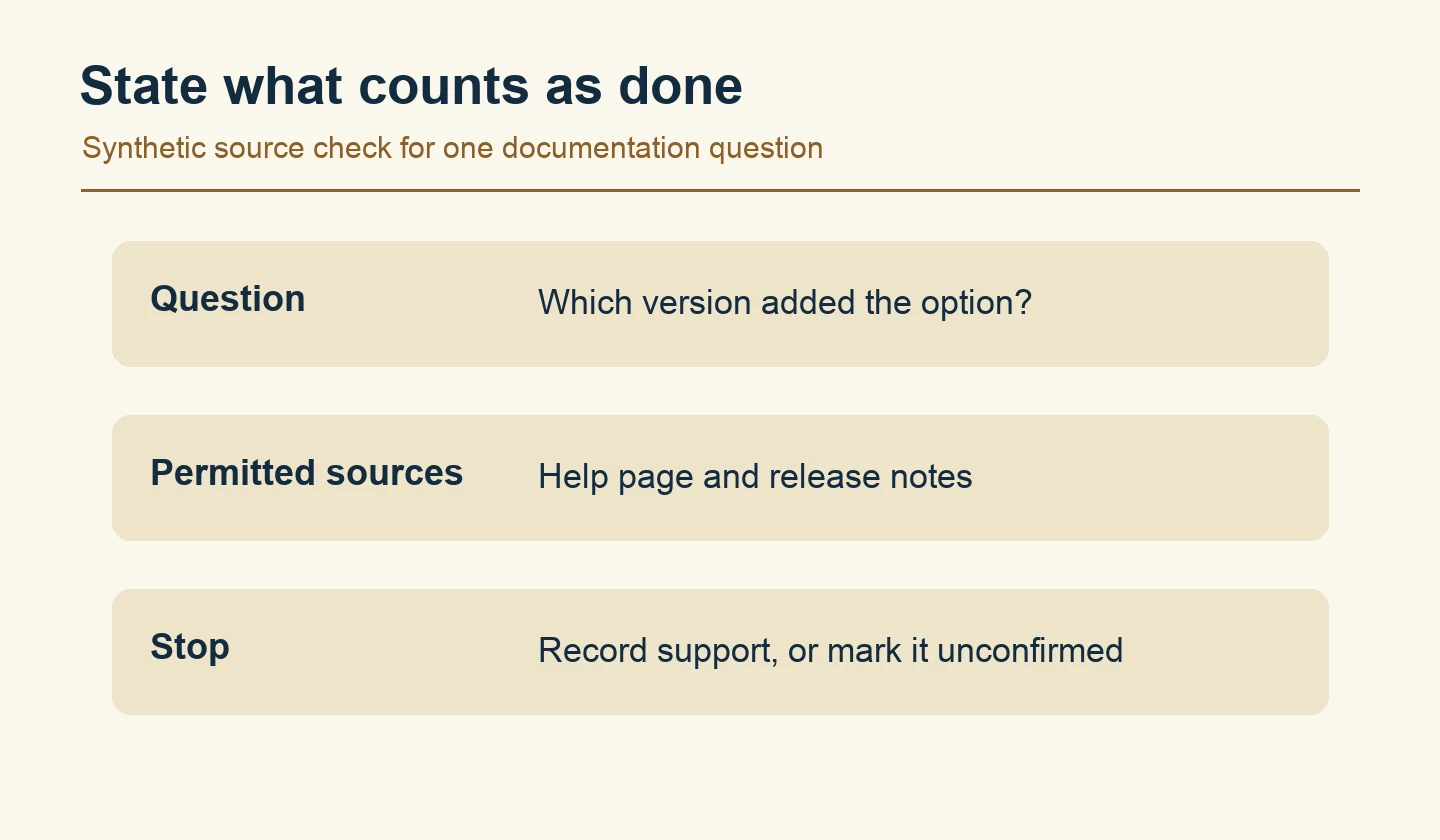
Start with a narrow question. In this example, a reader wants to know which version of an imaginary app added a setup option. The system can read two public documents, the help page and the release notes. Its task finishes when it finds a relevant version and an identifiable source passage, or reaches the lookup limit.
The goal, tools and stop condition explain what kind of behavior you should expect to see. The product name or presence of a chat box gives you much less evidence about the steps it can take.
Sources: Google for Developers
Watch what happens after the first lookup
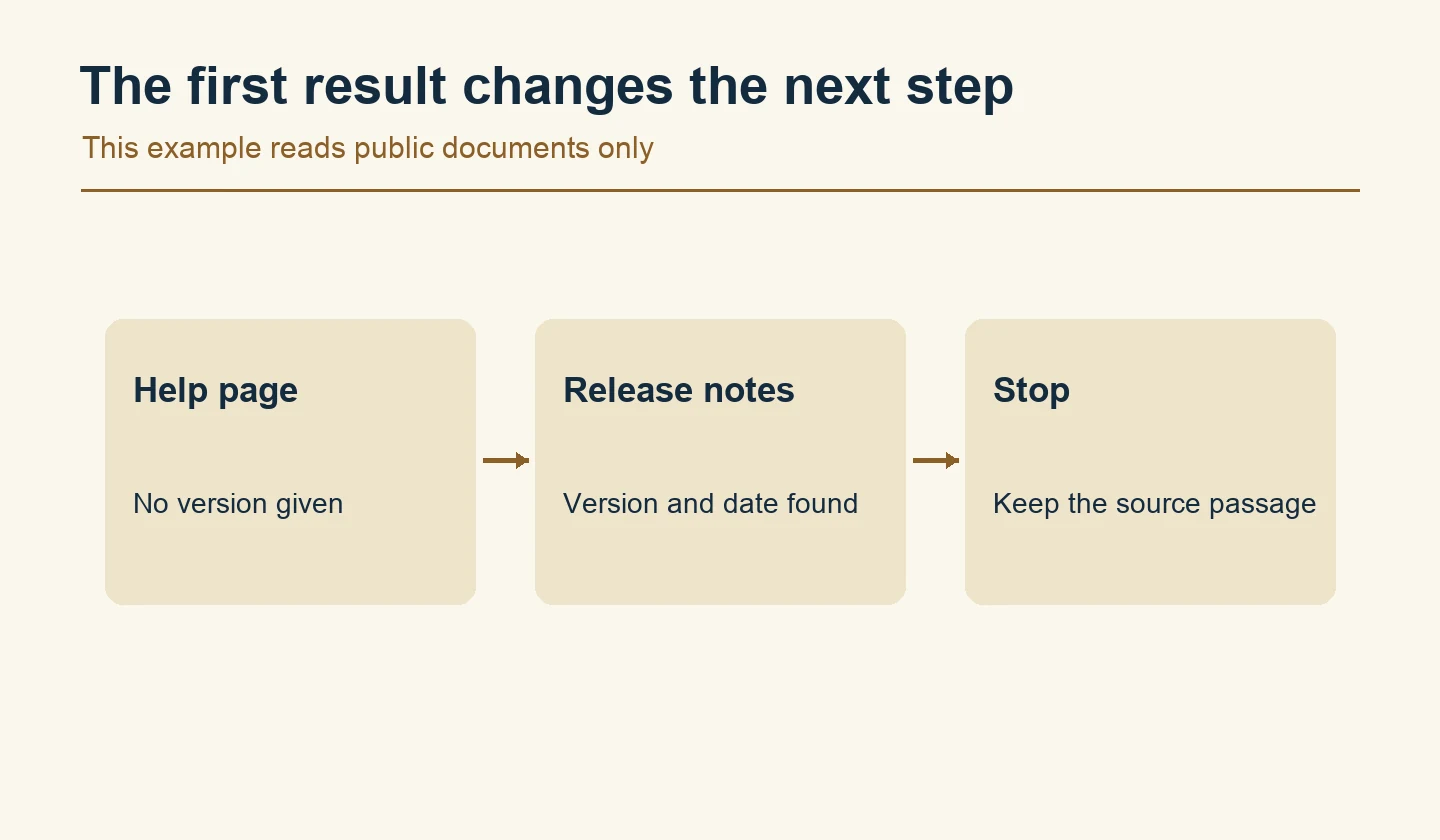
A fixed check can fetch both documents every time. That is useful when the same two sources will always be relevant. In an agentic setup, the result of the first lookup can change what happens next. The help page identifies the option but omits the version. That gap gives the system a reason to consult the second document.
A useful trace identifies the gap and the permitted follow-up. If the help page already contained a well-supported version and the system stopped, that would also fit the stated goal. The number of lookups alone does not identify the behavior.

Two useful ways to arrange the same task
Fixed workflow
Fetch the help page and release note in the same order for every check.
Agentic trace
Inspect the first source, then select a permitted second lookup only if a gap remains.
Compare the workflow and agent examples in Building effective agents.
Sources: Google for Developers · Anthropic
Read the example trace
The table shows a fictional sequence. The first observation explains why the second action follows. The second document supplies support for the specified detail. An auditable result records the claim and attaches the passage used to answer it.
If the release notes omit the relevant version, keep the value marked as unconfirmed. A short trace is still useful in this case. It shows what the system checked and exactly where the evidence ran out.
| Step | Observation | Next action |
|---|---|---|
| 1 | Help page shows the setup steps but gives no version | Check the named release notes |
| 2 | Release notes identify the relevant version and date | Read the matching entry |
| 3 | The required support is present in the example | Stop and save the evidence |
Sources: Google for Developers · Anthropic
For an answer readers will review later, map the in-text citation to the exact reference entry before judging whether the source actually supports the claim.
Keep the source attached to the claim
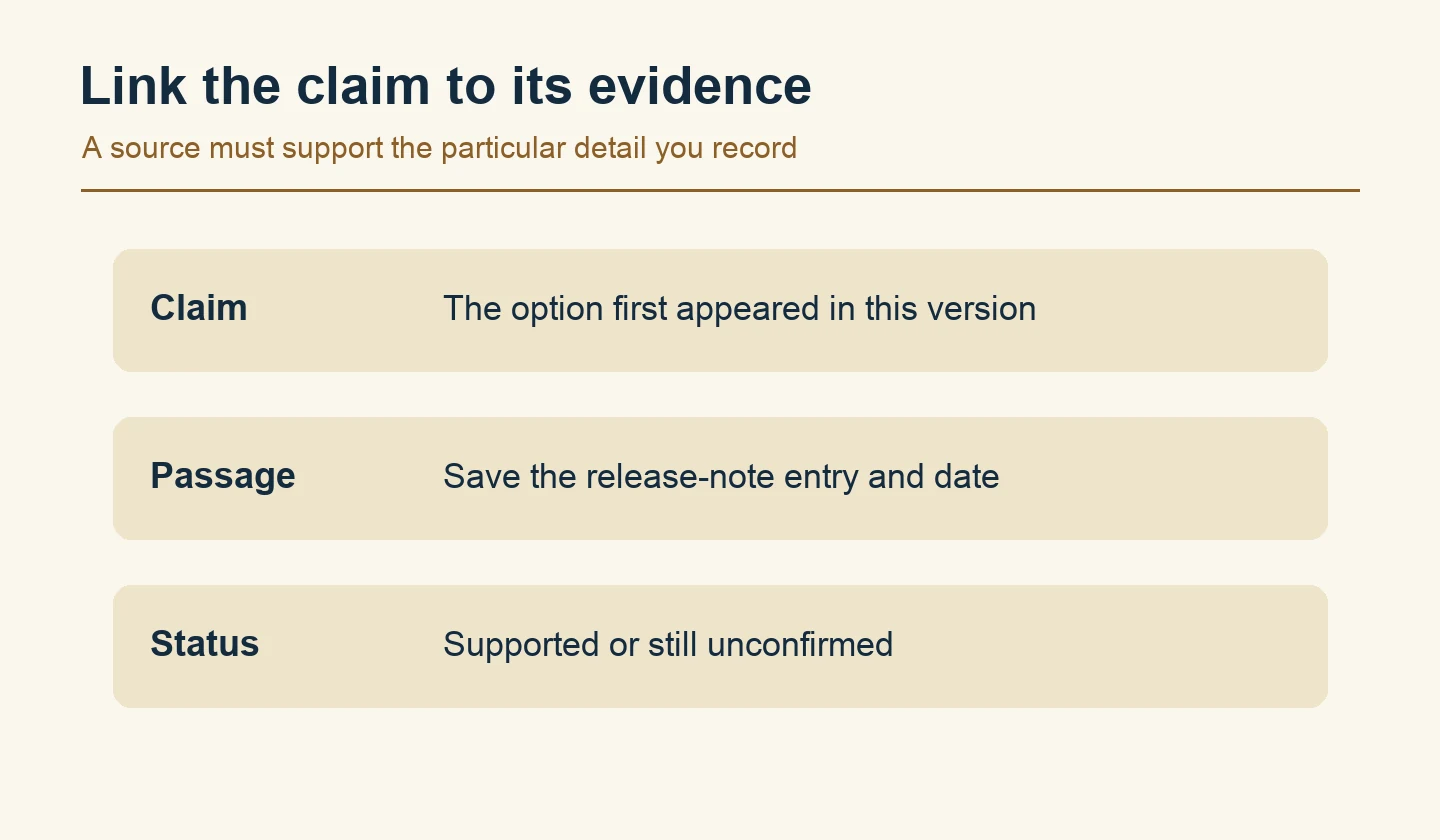
A response can cite a page that mentions the feature without resolving the version question. Check the actual passage before treating that as support. Relevant grounding metadata can identify a section of generated text and link it to the source chunk used. A visible link gives you somewhere to check. The passage must support the specific claim you are recording.
Record both the result and what the cited passage says. That distinction carries over to an AI visibility report that collects claims about a website from more than one answer.
Read what text segments and source chunks mean in the GroundingMetadata schema.
Sources: Google Cloud
Audit the behavior you can observe
Keep the exact question and the date, and put the observed result in a separate field from your interpretation. If the product gives you a trace, record the first meaningful observation and its follow-up. If it exposes only an answer, record the answer and the sources you can check. A repeatable note lets you compare two runs using the evidence each actually supplied.
Record the behavior you can verify
- Keep the exact question and permitted source list.
- Note the observation that led to a follow-up.
- Save the passage supporting the answer.
- Record when the system stopped or left the claim open.
For the related task, see Read how retrieval supports generation.
Sources: Google for Developers · Anthropic
Frequently asked questions
Is every answer with a source link agentic?
Inspect the product’s behavior or trace. A source link can be produced by a fixed retrieval process.
Can an agent be restricted to public read-only tools?
Yes. A system can choose among a small permitted set and stop at an explicit limit.
Does grounding establish that an answer is correct?
Grounding can connect a segment to source material. Read the passage to check whether it actually supports the claim.
Can I infer an engine’s orchestration from one answer?
One visible answer has limited evidence. Record the observable behavior and any trace or provider documentation available.
My AI Search ReportCompare AI citation audits
Use equivalent completed tests before comparing results.
Compare AI citation auditsContinue with a related guide
- Compare AI citation audits
Use equivalent completed tests before comparing results.
- Read how retrieval supports generation
Separate passage retrieval from the behavior that chooses when to retrieve.
- Compare citations and mentions
Write down which form of evidence you actually saw.
References
- Machine learning glossary: agentic Google for Developers
- Building effective agents Anthropic
- GroundingMetadata schema Google Cloud