How to Compare Two AI Citation Audits When Some Questions Fail
Compare citations on the questions both audits answered, then show how newly observed and missing responses affect the totals.

 My AI Search Report
At a glance
Compare the same completed questions in both audit runs and show the coverage alongside the results.
In this guide
Before comparing two AI audits, find the neutral questions that returned an observable answer in both runs. Compare citation counts on that shared set, then report the original run totals and completion beside it. That lets a reader see where the change came from when one service finished more questions the second time.
Keep the question and observation fixed
Save the exact prompt and its stable ID for every question. Preserve the engine, observation window, locale and method used to check the answer. Group comparisons by engine so a result on one answer surface is measured against the same surface in the next run. A revised prompt may deserve its own trial, especially when it changes the audience, location or type of answer requested.
For each observed response, record whether it linked to the domain, mentioned the brand without a link or did neither. Keep a separate entry for a timed-out, failed or unavailable response. A visible answer without your site supplies evidence about the question. A failed check leaves that question unobserved.
Keep the same questions and observation method for the second run. Set up the original ten-question audit.
Sources: Google Search Central
Match the successful question IDs
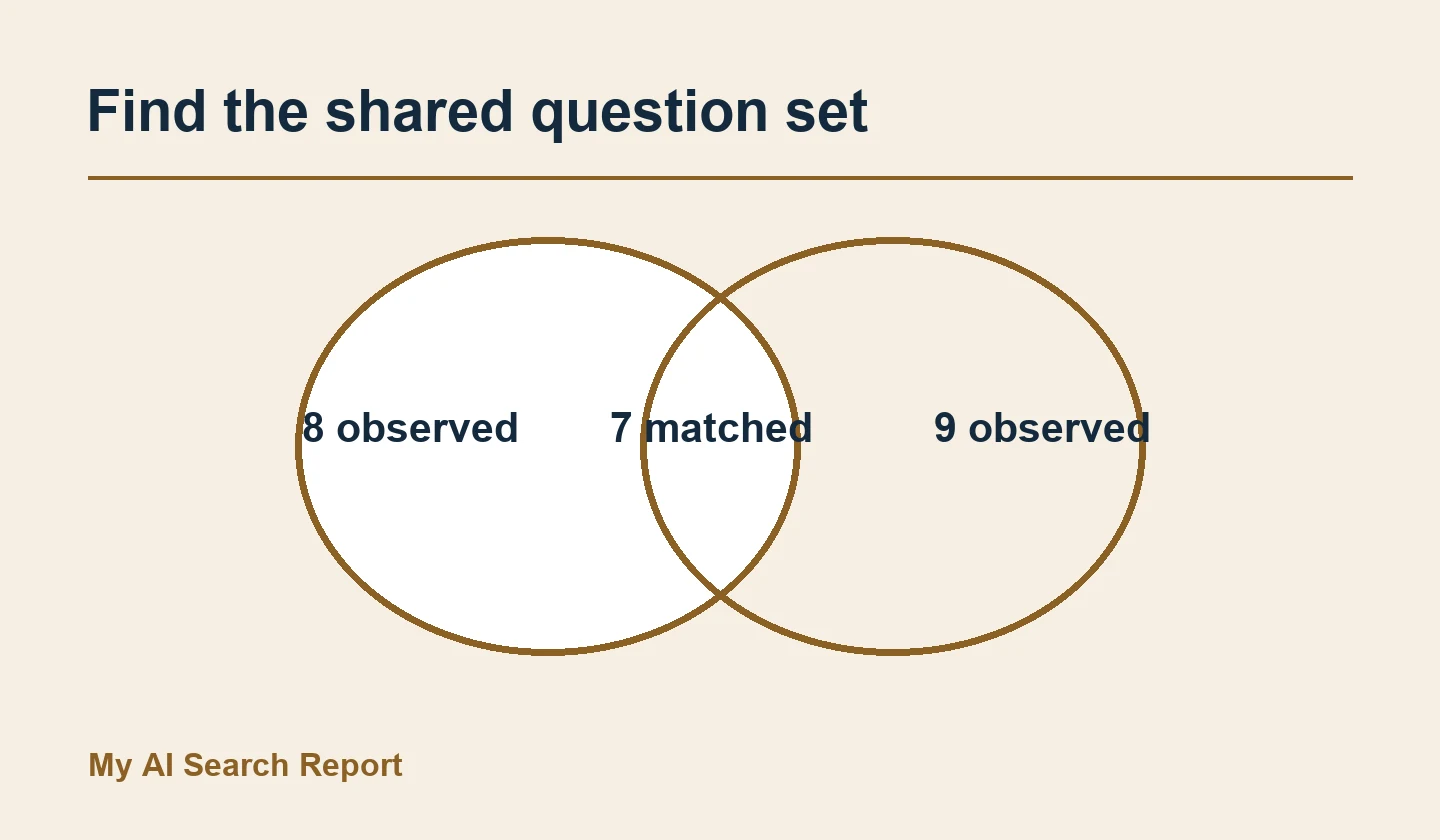
Imagine a ten-question run in which the first check returned eight answers with two citations and the second check returned nine answers with four citations. The overall observed rates are 2 of 8 and 4 of 9. Look for which questions returned answers both times before calling the difference a change under the same conditions.
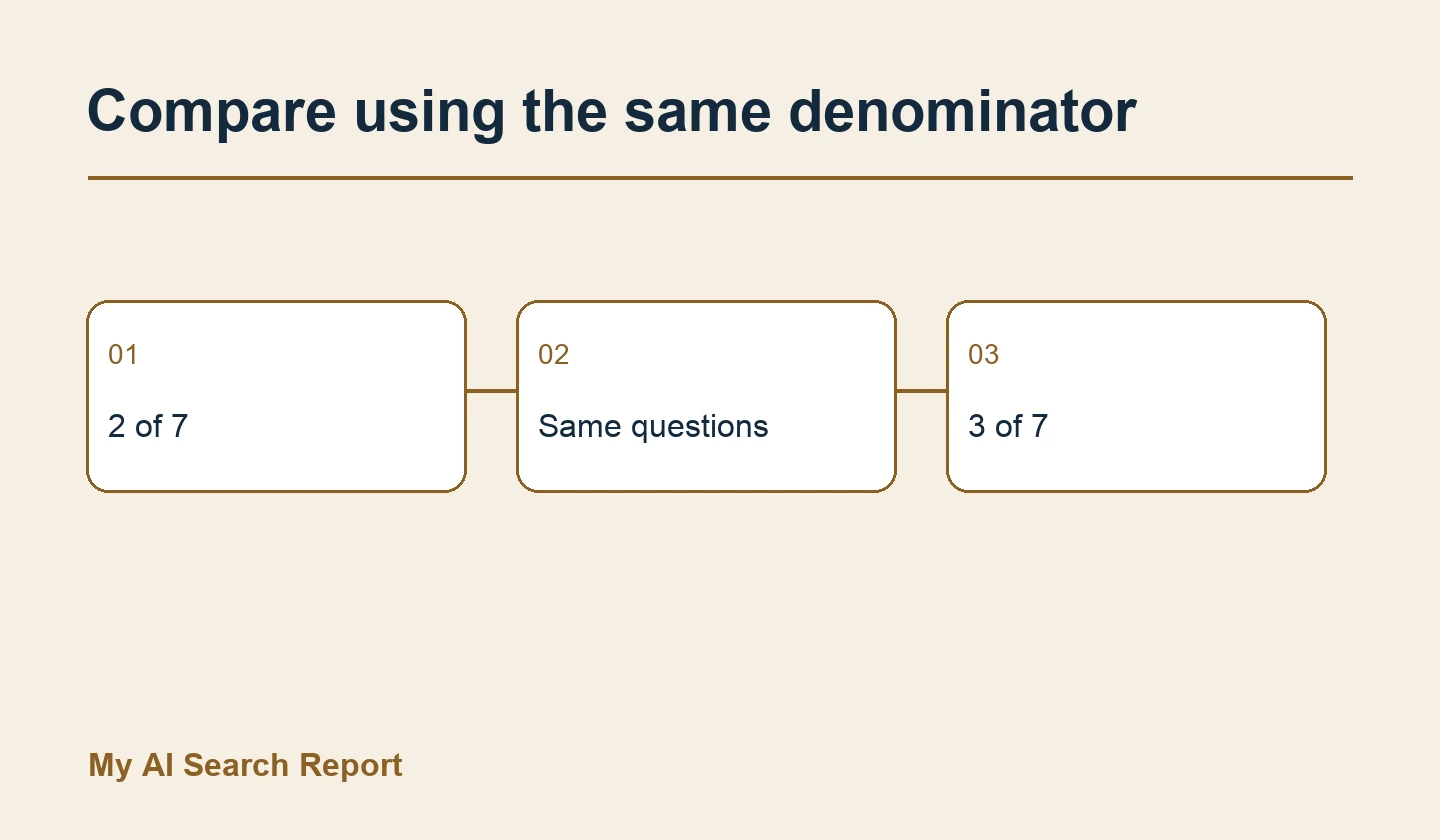
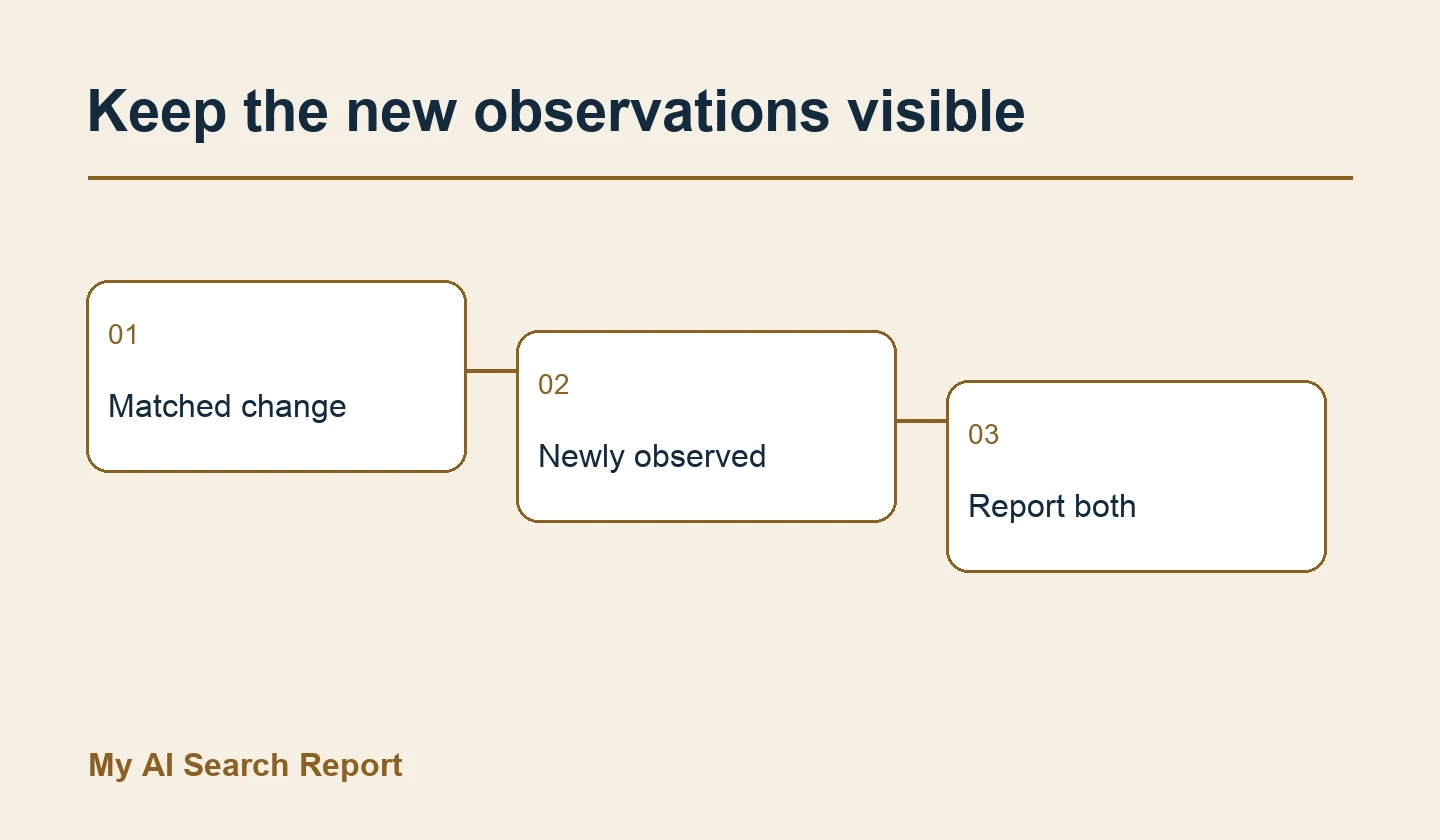
Suppose seven questions appear in both sets. On those seven matched questions, the domain was cited twice in the first run and three times in the second. A fourth citation in the second run came from a question that had not returned an answer in the first. Report the two additional citation occurrences separately by their evidence.
Two separate measures
Matched citation comparison
Counts the observed citations across the same questions answered in both runs.
Coverage of the audit
Shows how many questions completed and what was missing from each run.
Google's AI features can show supporting links. Use a dated set of observed answers and distinguish linked citations and visible mentions from an unanswered check. AI features and your website.
Sources: Google Search Central
Show the changed rows and the missing rows
Build a small comparison table with one row per question. Include whether each run returned an answer, the citation state, any visible linked URL and the observation time. A change to a different page on the same domain can be meaningful when it aligns more closely with the question, even if the site-level citation count is unchanged.
Use care around a short list. One additional citation across seven shared questions shifts the displayed rate by roughly fourteen percentage points. Show the counts first, and preserve the exact question so you can inspect the difference. A visible answer may change when you repeat the test, even with the same wording.
| Scope | Run one | Run two |
|---|---|---|
| Original answers observed | 8 of 10 | 9 of 10 |
| Citations among original answers | 2 of 8 | 4 of 9 |
| Citations on shared question set | 2 of 7 | 3 of 7 |
| Citations outside the matched set | 0 | 1 |
Sources: Google Search Central
Decide what to investigate next
For a newly cited question, read the cited page and see whether it provides a fact, definition or worked example the answer uses. For a question that stopped citing your site, compare the sources that appeared before and after. Save the observations that can guide a specific page improvement. An engine's answer can draw from different sources between checks for reasons that this test does not identify.
Repeat unresolved checks in a separate pass and keep the first observation date attached. If you need to report that the audit completed later, mark the retry and publish its completion alongside the matched comparison. That way you can distinguish the cleanest comparable result from the broadest available evidence.
Make a two-column list of the exact completed IDs and mark the intersection before counting citations. In a shared row, preserve the citation URL that was actually returned. If the brand name appears without an attributable URL, record that as a mention. Those two observations are useful for different follow-up checks, especially when you rerun the same prompt after improving a page.
Before you finish
- Preserve question IDs and the surface being tested.
- Match only questions observed in both runs.
- Report citations and unlinked mentions separately.
- Show completion and the unmatched question results.

Use separate statuses for links, unlinked brand mentions and failed checks. Identify a citation versus a mention.
Sources: Google Search Central
Frequently asked questions
Should unavailable questions count as uncited?
Record their status separately. Use observed answers for citation coverage and show completion next to it.
Can I compare an answer from one engine with another engine on the same prompt?
You can compare them side by side. For change over time, match each engine with the same engine and record its conditions.
Should a failed question count as no citation?
Leave it unobserved. A failed answer does not show whether a citation would have appeared.
Can I pool two different answer engines?
Keep engine and conditions attached to the results. Compare like-for-like before interpreting changes across engines.
My AI Search ReportRun a free AI search check
Compare the same completed questions in both audit runs and show the coverage alongside the results.
Run a free AI search checkContinue with these guides
- Set up the original ten-question audit
Keep the same questions and observation method for the second run.
- Identify a citation versus a mention
Use separate statuses for links, unlinked brand mentions and failed checks.
- Run a free AI search check
Compare the same completed questions in both audit runs and show the coverage alongside the results.
References
- AI features and your website Google Search Central