In-Text Citation vs. Reference List: Put Each Claim Next to Its Evidence
A citation shows which source supports a claim. A reference entry identifies the source. Walk through an example before reviewing AI answers or publishing a page.

 My AI Search Report
At a glance
An in-text citation connects a specific passage to a source. A reference entry helps the reader find the source. Check the connection in both directions and then read the cited passage.
In this guide
An in-text citation tells the reader which source goes with the sentence or passage. A reference list entry tells them how to find that source. Use both parts when a claim matters enough to check later.
Identify the two different jobs
The in-text part sits near the claim. In a paper it may contain an author or title and, where appropriate, a page or other locator. MLA’s overview shows how that short indicator points to a particular works-cited entry. On a website the connection may be a descriptive link beside the relevant sentence.
The longer reference identifies the work itself. It can carry the title, publisher, date and stable link without crowding the paragraph. APA’s guidance describes the usual correspondence between the items cited in the text and the entries at the end.
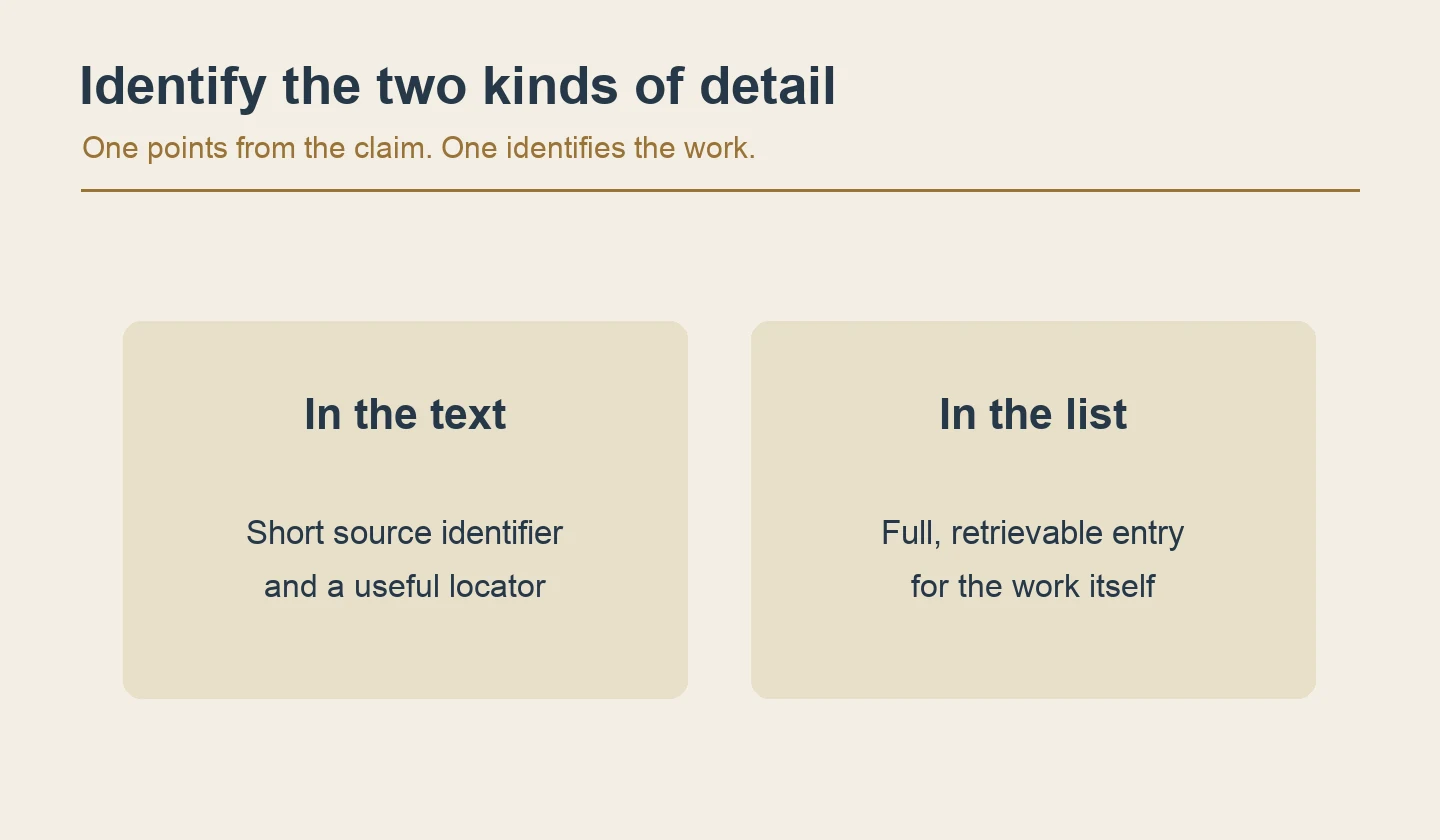
Use a different level of detail
In the text
Name or point to the relevant source at the claim.
In the references
Identify the work precisely so the reader can retrieve it.
For the role of a brief citation and an evidence locator, see In-text citations overview.
Sources: Modern Language Association · American Psychological Association
Attach the right source to each claim
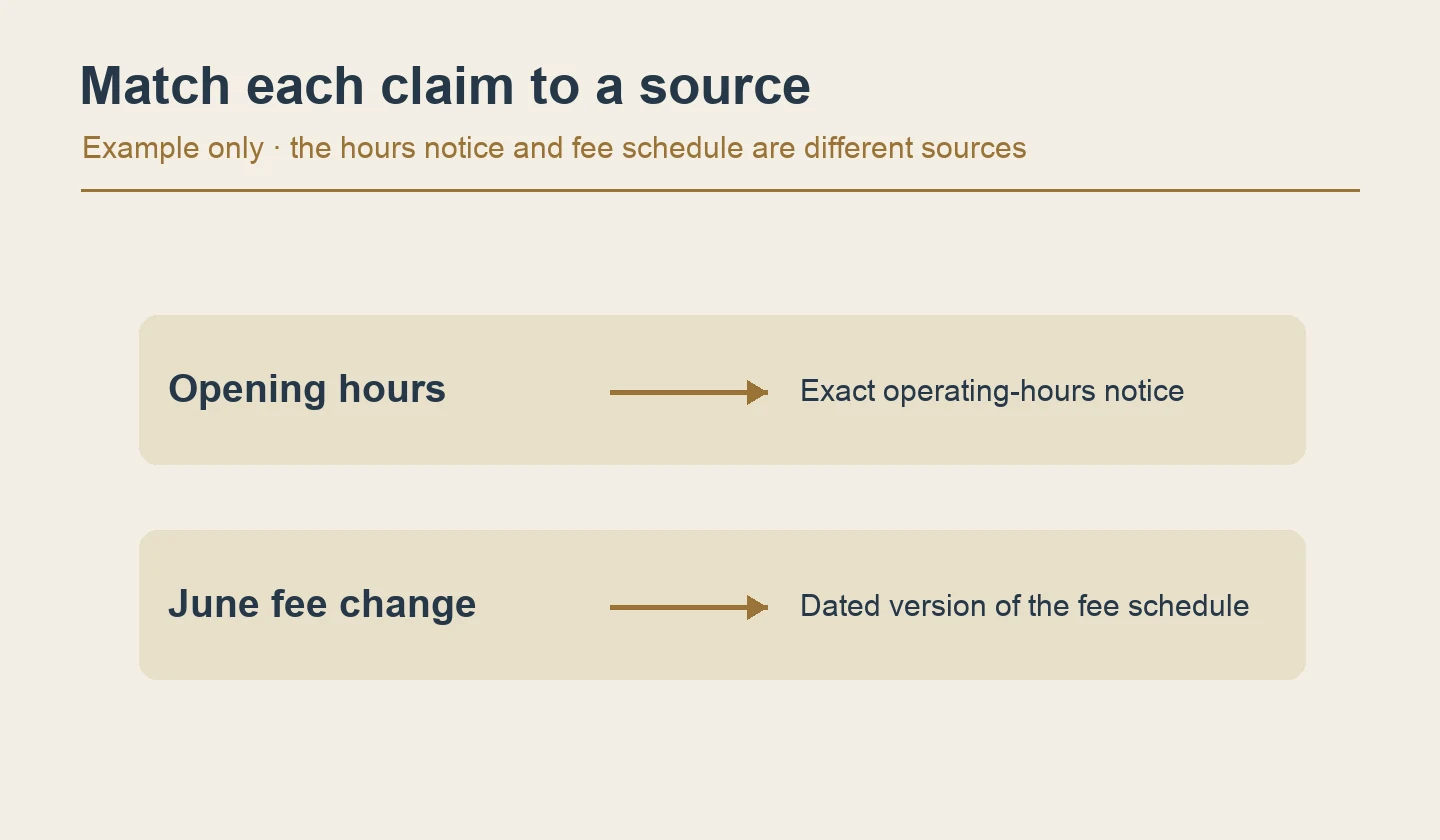
Imagine a paragraph that gives the hours for a local service and says a booking fee changes in June. Those two statements need different checks. Put the hours notice next to the line about operating times. Put the dated fee schedule next to the change, using the relevant section or dated version if the publisher has more than one.
A list of five links at the bottom of the page leaves the reader guessing which one proves the fee claim. Keep the reference list and still make the connection by the sentence. If the notice establishes the hours but says nothing about fees, cite it only for the information it supports.
| Claim | Use next to the sentence | Keep at the end |
|---|---|---|
| A service’s operating hours | The operating-hours notice | Exact notice title, publisher and URL |
| A fee changes in June | The dated fee schedule | Title, date and link to that version |
| The source gives no coverage for a third claim | Leave the gap visible | Find an additional source or qualify the claim |
Sources: Modern Language Association · American Psychological Association
Test whether the reference supports the sentence
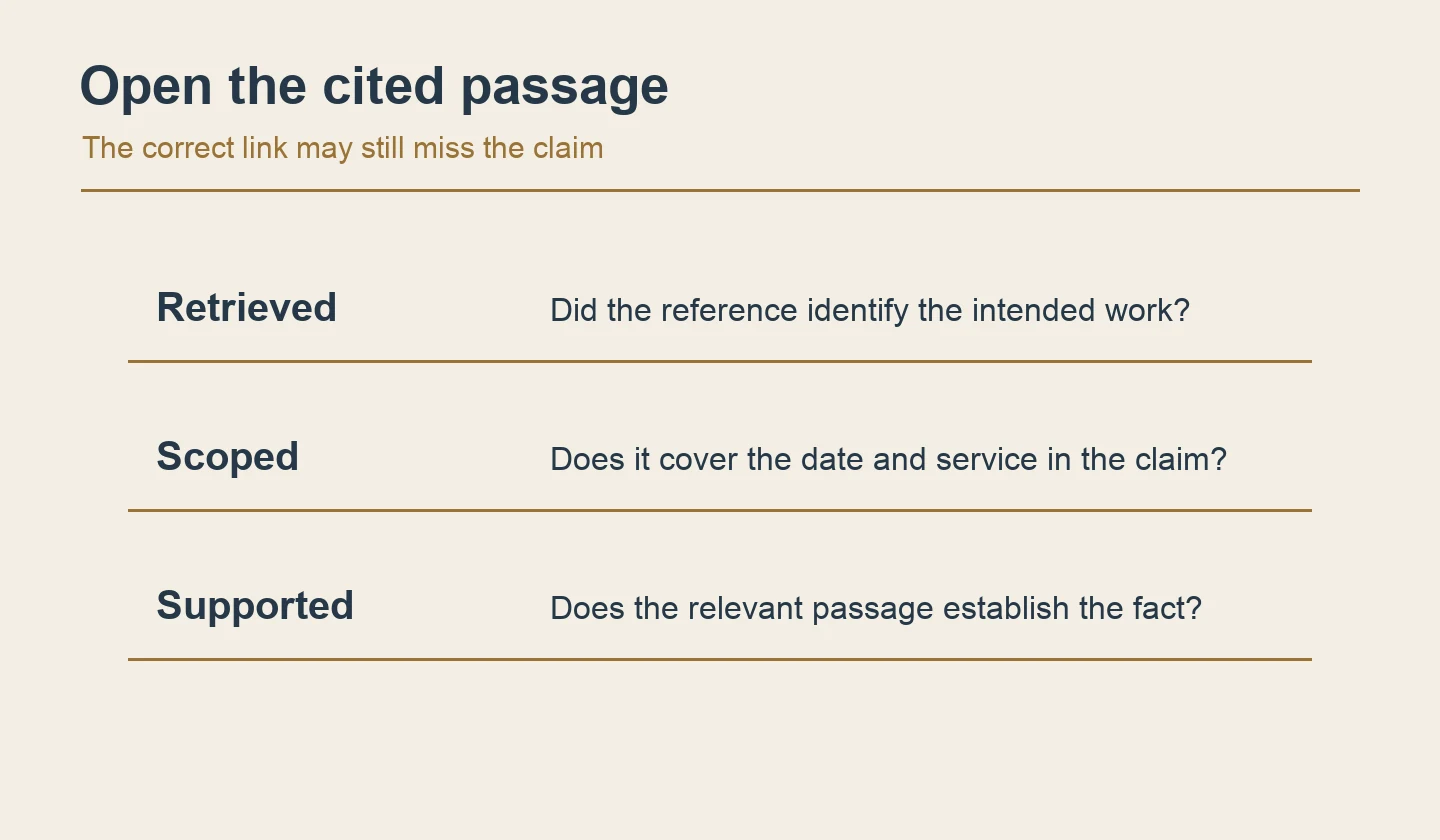
Open the link from the citation and read the exact passage. Look for the time, service, place and version that your sentence uses. For an AI-generated answer, perform the same check. A link next to a claim can look authoritative even if its page discusses a different year or service.
Record what you checked in a small two-column note: claim on the left, source and locator on the right. When an item cannot be retrieved, distinguish that limitation from a wrong link or an unsupported assertion. Formal styles also have rules for cases such as personal communications. Use the relevant rule without letting an unavailable source look like one the reader can open and verify.
Check the path from claim to passage
- Underline the part that needs evidence.
- Trace the short in-text citation to one clear reference.
- Open the source and locate the relevant passage.
- Separate a missing source from a source that does not support the claim.
For the usual in-text and reference-list correspondence, see Creating an APA Style reference list.
For an example of a documented style exception, see Personal communications.
For the related task, see Check whether a linked source actually supports the cited claim.
Sources: Creating an APA Style reference list · Personal communications
Frequently asked questions
Does a hyperlink automatically count as evidence?
Its destination must make the needed fact or observation verifiable.
Can I use the same reference for several sentences?
Yes if the source supports them and the reader can see which claims the citation covers.
Do APA and MLA use the same formatting?
No. Follow the required style for headings, short citations, dates and locators.
Do all cited things appear at the end?
Many works have matching reference entries. Some style-specific exceptions, such as certain personal communications, are handled in the text.
My AI Search ReportFollow an AI source-check trace
Keep the observed source beside the claim.
Check which claims the AI source trace establishesContinue with a related guide
- Follow an AI source-check trace
Keep the observed source beside the claim.
- Check whether a linked source actually supports the cited claim
Separate citation appearance from accuracy.
- Separate citations, mentions and visits in your audit
Record the evidence type you actually observed.
References
- In-text citations overview Modern Language Association
- Creating an APA Style reference list American Psychological Association
- Personal communications American Psychological Association