What database does ChatGPT use?
A clear explanation of how ChatGPT stores and retrieves information: learned model parameters, training sources, optional web search, your uploaded files, and connected tools.
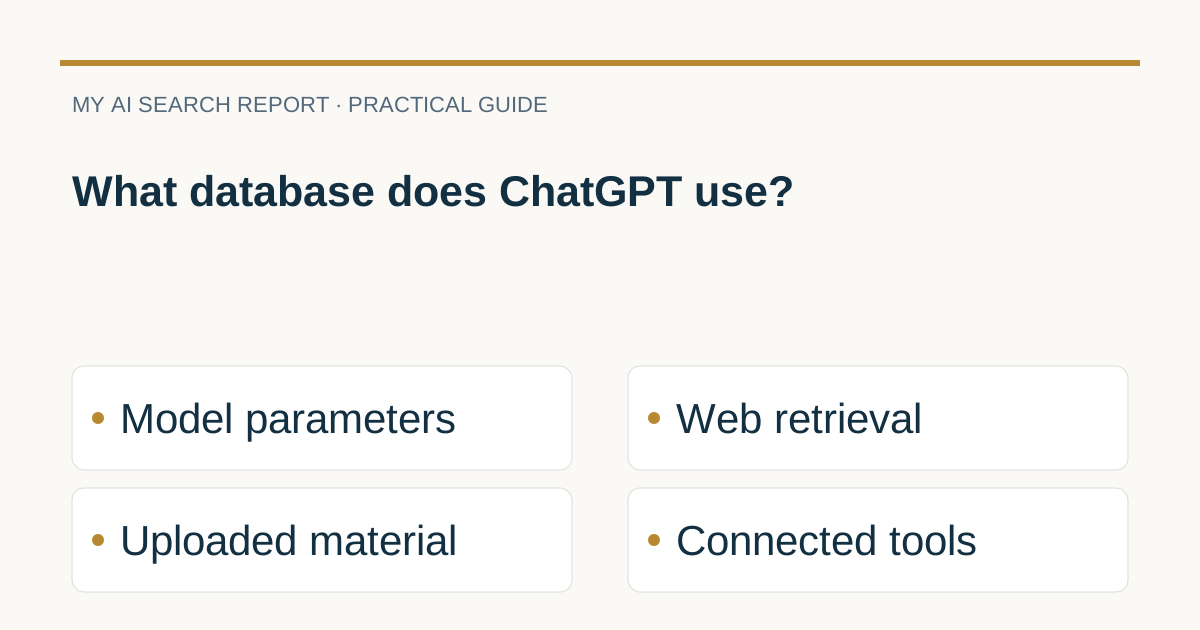
Short answer: ChatGPT doesn’t use a single live SQL-style database to look up facts. It generates answers from learned model parameters trained on a mixture of sources, and can optionally pull in current information via web search or connected tools when you enable them. Your uploaded files and saved content live in your ChatGPT account and are separate from the model itself (OpenAI Help: How ChatGPT models are developed; OpenAI Help: Searching the web with ChatGPT).
How ChatGPT “knows” things: learned parameters, not a facts database
ChatGPT is a model made of learned weights (parameters). During training, the model learns patterns from large-scale text and other data and adjusts those weights to predict the next likely word. OpenAI explains that models do not store copies of their training data; instead, they encode patterns in parameters used at inference time (OpenAI Help). This is why there isn’t a single, queryable “knowledge database” behind every answer.
What training data is used to develop the model?
- Mixture of sources: OpenAI states that foundation models are developed using three primary sources: publicly available internet content, data accessed via third-party partnerships, and information provided or generated by users, trainers, and researchers (OpenAI Help).
- Quality and safety filtering: OpenAI says it applies filters to reduce undesirable material and does not intentionally gather data from known paywalled sources or the dark web (same source).
- Site controls: Website owners can use robots.txt to disallow GPTBot from accessing content for training (same source). For a practical overview of OpenAI’s crawler in search contexts, see What is OAI-SearchBot?
What can ChatGPT use at run time?
1) Optional web search
- Current answers with links: ChatGPT can search the web and include citations to relevant sources when the question benefits from up-to-date information (OpenAI Help).
- How it searches: It may rewrite your prompt into targeted queries and send them to third‑party search providers; it can share a general location inferred from your IP to improve local relevance, but it does not share your IP address or your ChatGPT account information with those providers to run the search (same source).
- Check citations: Results and citations can be incomplete or incorrect; open cited sources to verify claims and publication dates (same source). For more on interpreting AI references, see How accurate are AI citations?
2) Your uploaded files and saved content
- Account storage, not the model: Web search is different from sidebar search, which helps you find your existing chats, projects, and files saved in your ChatGPT account. Those assets are stored with your account and are not the model’s internal knowledge (OpenAI Help).
3) Connected tools and partner integrations
- Examples: For restaurant reservations, ChatGPT may show availability from providers like OpenTable, Resy, or Yelp. If you choose to book, it can ask permission to share your name and email with the reservation provider to fill visible booking fields (same source).
Privacy and controls you can use
- Conversations and training: OpenAI’s help material links to options for opting out of having your ChatGPT conversations used to help improve models; see that guidance and the Privacy Policy from the same article (OpenAI Help).
- Location sharing: You can review or disable precise device location in ChatGPT’s Data controls. ChatGPT may still infer a general location from your IP to improve local results (OpenAI Help).
- Site owners: Use robots.txt to manage training access for GPTBot (OpenAI Help). Our overview of OAI-SearchBot explains making content available for AI search experiences.
Actionable checklist
- Need current info? Turn on Search in ChatGPT and verify linked sources before acting (OpenAI Help).
- Review Data controls to manage location sharing and tool permissions (OpenAI Help).
- Be mindful of sensitive data in prompts; review OpenAI’s guidance on how conversations may be used to improve models (OpenAI Help).
- Site owners: use robots.txt to control GPTBot training access; see our OAI-SearchBot guide.
- When citations appear, open them. If something looks off, ask ChatGPT to search again with a specific source or date (OpenAI Help).
FAQ
Does ChatGPT use a specific database like MySQL or a vector DB?
No public documentation indicates a single live database for answers. OpenAI describes models as learned parameters rather than a lookup database, with optional web search and tools for current data (OpenAI Help; OpenAI Help).
Why do answers sometimes change?
There is inherent randomness: multiple plausible next words can fit, so outputs can vary across runs even with similar prompts (OpenAI Help).
Put this into practice
Identify whether the question concerns model training, a live web lookup or a connected data source. Check the product’s current documentation rather than assuming one database explains every answer or every version.
Sources and further reading
- OpenAI Help: How ChatGPT and our foundation models are developed
- OpenAI Help: Searching the web with ChatGPT
Provider documentation can change. Check the current guidance before changing crawler or search settings.