What Does Grounded Mean in AI? Check Each Claim Against Its Sources
Use a worked example to tell supported, unsupported and conflicting claims apart, then decide which evidence the answer needs.

 My AI Search Report
At a glance
An answer is grounded to the extent that its claims follow from the supplied evidence. A topically relevant source can still leave a detail unsupported. A full answer also depends on current, reliable evidence.
In this guide
An AI answer is grounded when the claims it makes are supported by the reference material it has been given. You can test that on a small answer by checking whether each claim follows from the passages. An answer can be grounded in an old source and still give the wrong advice for today.
Mark what the supplied passages actually establish
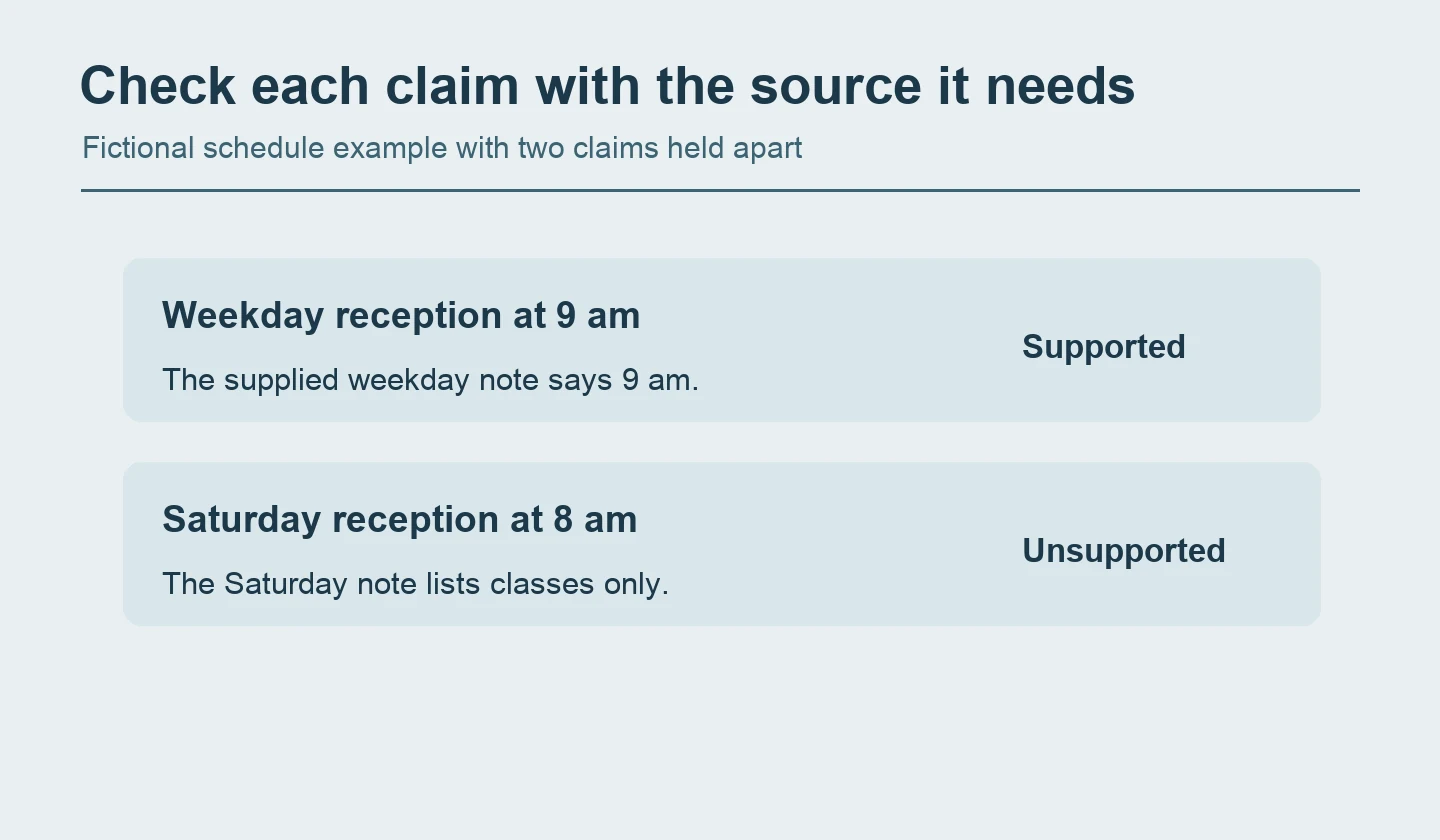
Imagine an assistant gets two notes about a fictional studio. The first, a dated schedule, says that weekday reception opens at 9 am. The second lists Saturday classes but gives no reception time. If the answer says weekday reception opens at 9 am and Saturday reception opens at 8 am, there are two claims. The first follows from the first note. The other time appears in neither note.
A passage about Saturday is relevant. It still does not establish what time the desk opens. That distinction is what makes a grounding check more precise than counting links. A reference can be close enough in topic to look right and still leave a figure, date or condition unsupported.
| Claim | Given evidence | Finding |
|---|---|---|
| Weekday reception at 9 am | Weekday schedule states 9 am | Supported |
| Saturday reception at 8 am | Original notes list classes only | Unsupported |
| Saturday reception at 8 am after adding an explicit notice | Additional reception note says closed | Conflicts with a supplied fact |
For the source-based definition of grounding, see Grounding overview.
Sources: Grounding overview · Check grounding with RAG
Keep conflicting evidence and missing evidence apart
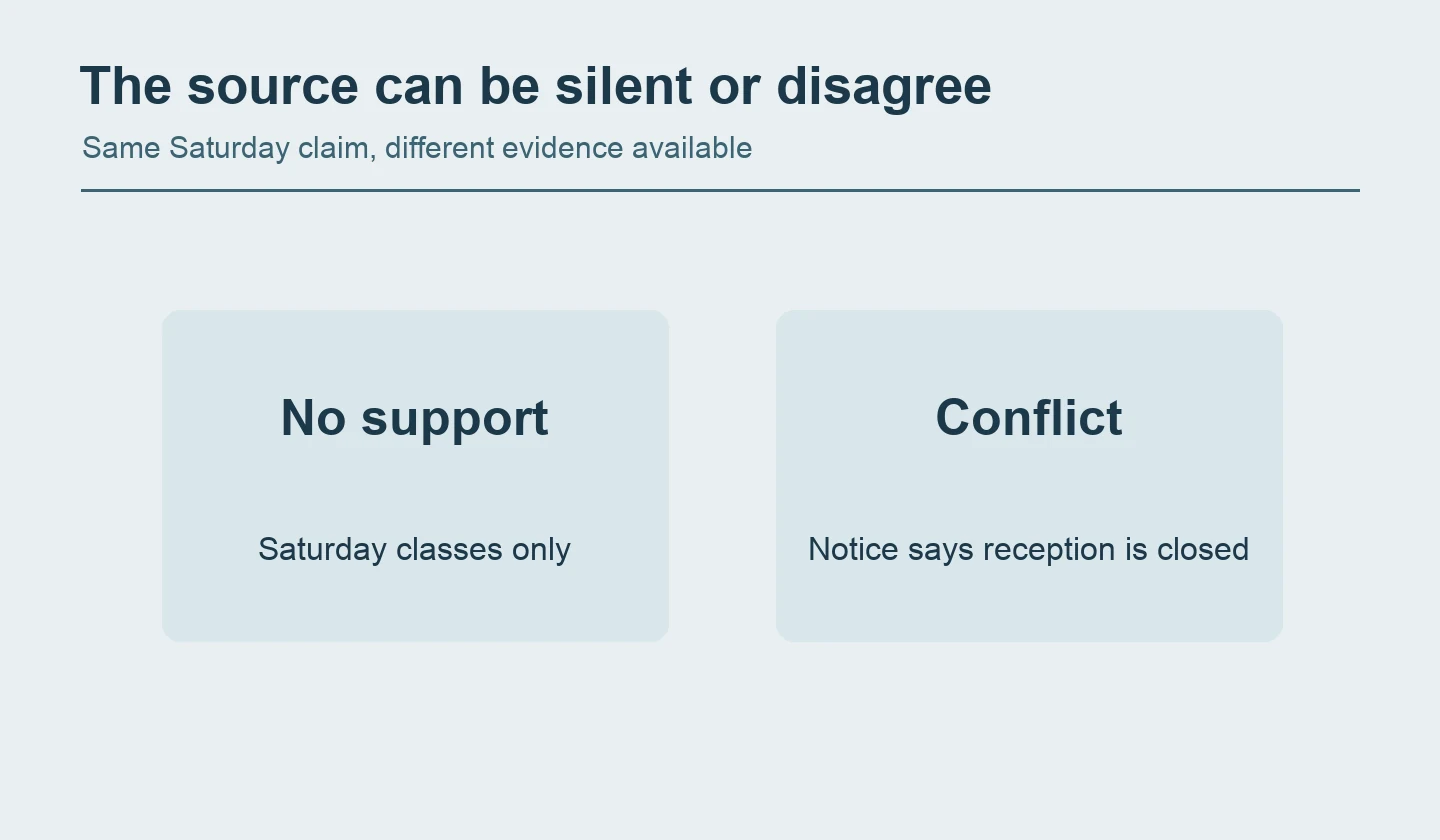
Consider what changes if a third note explicitly says Saturday reception is closed. The 8 am statement now conflicts with a supplied fact instead of merely having no support. Record those cases separately. If two dates name different hours for different service periods, attach the periods to their own claims before deciding that the references contradict each other.
Google Cloud describes a checking method where supplied facts can be associated with individual claims in the answer. For a manual review, mark the crucial number or condition in the claim, copy an evidence locator, then give it a short status. If the sentence contains two requirements and only one is supported, split it or record that it is only partially supported.
Two ways a claim can fail the grounding check
No support
The supplied Saturday note says nothing about reception hours.
Conflicting evidence
A later-added note says the Saturday desk is closed, contradicting the 8 am claim.
For one implementation that compares claims with facts, read Check grounding with RAG.
Sources: Check grounding with RAG · CheckGrounding REST reference
Give the answer what it needs, or narrow the answer
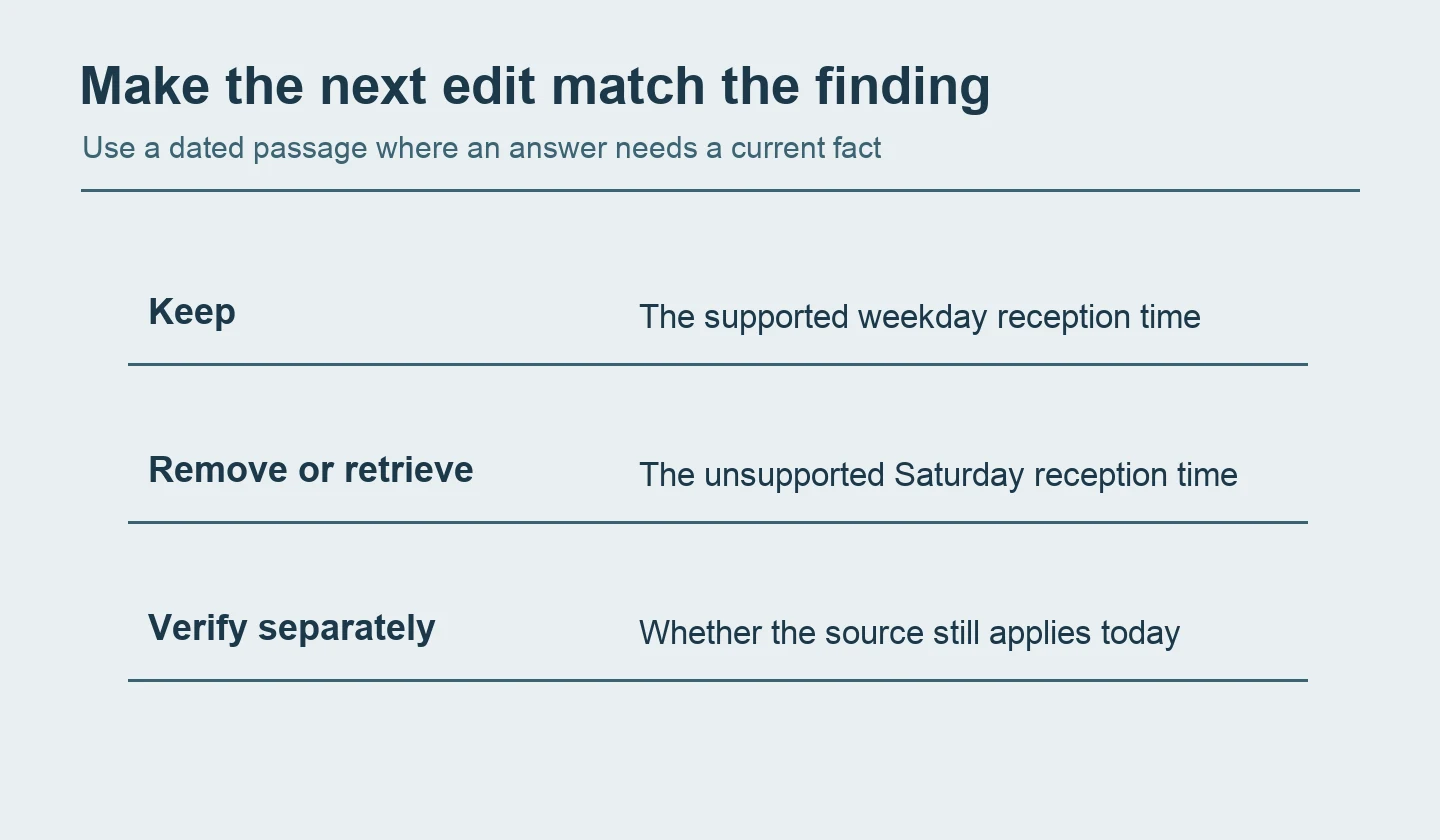
When the Saturday schedule is missing, remove the time from the answer or retrieve a current source that actually establishes it. With the notes above, an answer could give the weekday time and say that no Saturday reception time appears in the supplied notes.
Keep a separate reminder to check freshness. If a week-old notice replaces last year’s hours, the answer can accurately reflect the old passage and still mislead a visitor now. Save the source version, its effective dates and the claim that each passage supports. That record helps you tell whether your next change belongs in the content, the retrieval setup or the answer itself.

Check the support before keeping the answer
- Split claims with more than one detail.
- Find the exact evidence or label it missing.
- Record conflicting facts and effective dates.
- Retrieve better evidence or give a narrower answer.
To see how claim and fact identifiers can support later review, see CheckGrounding REST reference.
For the related task, see Tie specific statements to their references.
Sources: Grounding overview · Check grounding with RAG
Frequently asked questions
Is grounded the same as factually correct today?
Grounding here checks support against the supplied references. A dated or unreliable reference can make the information inaccurate today.
Can a related page support a number it never states?
A related topic alone does not establish a value. Check whether the number actually follows from the reference.
What if two sources specify different dates and times?
Record their effective periods first. They may be describing different situations.
Should I keep a claim if the authorized sources give no answer?
Give the supported part and state what is missing, or retrieve a better current source.
My AI Search ReportVerify the source links in an AI answer
Check the source identity before judging support.
Verify the cited passageContinue with a related guide
- Verify the source links in an AI answer
Check the source identity before judging support.
- Tie specific statements to their references
Keep a visible connection between each statement and its evidence.
- Keep AI citations separate from mentions and visits
Track what the answer actually reveals.
References
- Grounding overview Google Cloud
- Check grounding with RAG Google Cloud
- CheckGrounding REST reference Google Cloud