Is 80% Accuracy Good? Count the Citations a Detector Missed
Use ten labeled examples to test whether a seemingly good accuracy score hides missed citations in AI answers.

 My AI Search Report
At a glance
Compare the detector with a simple baseline on the same labeled answers. Keep the missed citations and false flags beside the accuracy score.
In this guide
An 80% accuracy result can hide failure on the outcome you care about. In a fictional audit of ten AI answers, two contain a citation to the site being checked. A detector that says “no citation” every time gets eight answers right and misses both citations. To evaluate the detector, keep the same answers, label them independently and count which cases it misses.
Define what counts as a citation
Save the ten completed answers with their source links. Decide on the site or set of hostnames before you label them. For this exercise, an answer is positive when the saved response lists a source URL on the exact hostname you are testing. An unlinked brand mention may be worth tracking, but it goes in its own column. Read the linked destination or hostname with the label in view so you can explain ambiguous cases.
Record each failed or unavailable scan separately. A missing response has no answer to judge. Keep the number attempted beside the number completed, and use only the manually reviewed answers for this particular classifier comparison.

Sources: scikit-learn
Run the simplest baseline first
Before checking an automated detector, write down what a rule that always says “absent” would do. It is right on eight of the ten answers and wrong on the two that include the site. That is 80% accuracy and 0% recall for the citation class. The rule never predicts a citation, so its precision for that class has no denominator.
A small accuracy scorecard should include the class counts. Otherwise the same 80% can describe a detector that found real citations or a rule that never tried to flag one. The eight correct absences matter, but they do not answer how often it finds a citation.
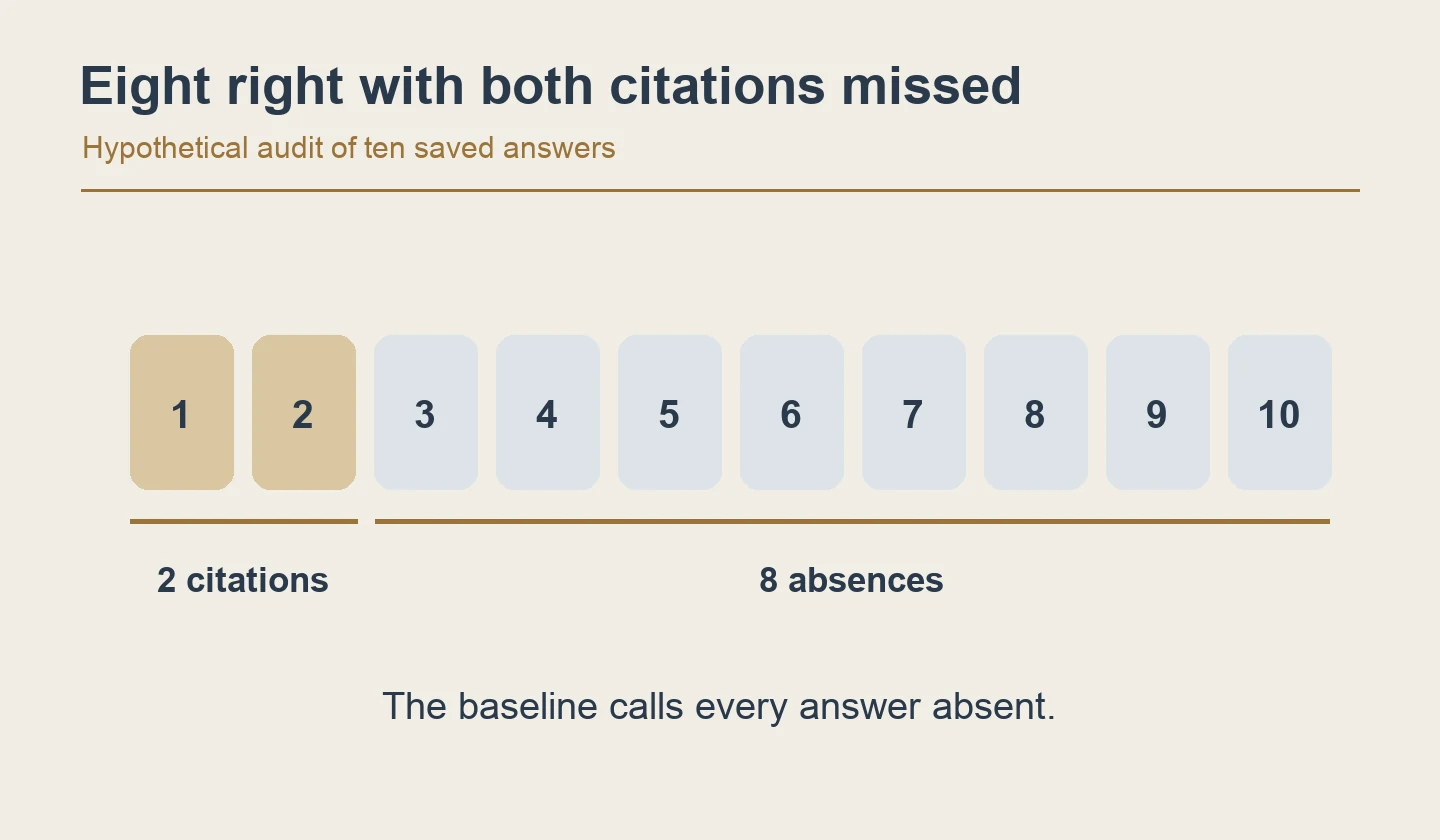
Check zero-denominator behavior in Precision score documentation.
Sources: Confusion matrix documentation · Precision score documentation
Open the row behind each error
Now suppose a different detector flags three answers in those same ten. It correctly flags the two citations and flags one of the eight non-citations. This fictional detector gets nine answers right. Its precision is two correct flags out of three and its recall is two found citations out of two. The one false flag is the next case to read.
Write where the error came from. A URL to another site, an unlinked brand mention or a redirect outside the chosen host can produce different kinds of mistake. Keep the intended test definition with the problem row so the next reviewer uses the same rule.
| Result | Always absent | Flags three |
|---|---|---|
| Correct citations | 0 | 2 |
| Missed citations | 2 | 0 |
| False flags | 0 | 1 |
| Correct absences | 8 | 7 |
| Positive precision | Undefined | 2 ÷ 3 |
| Positive recall | 0% | 100% |
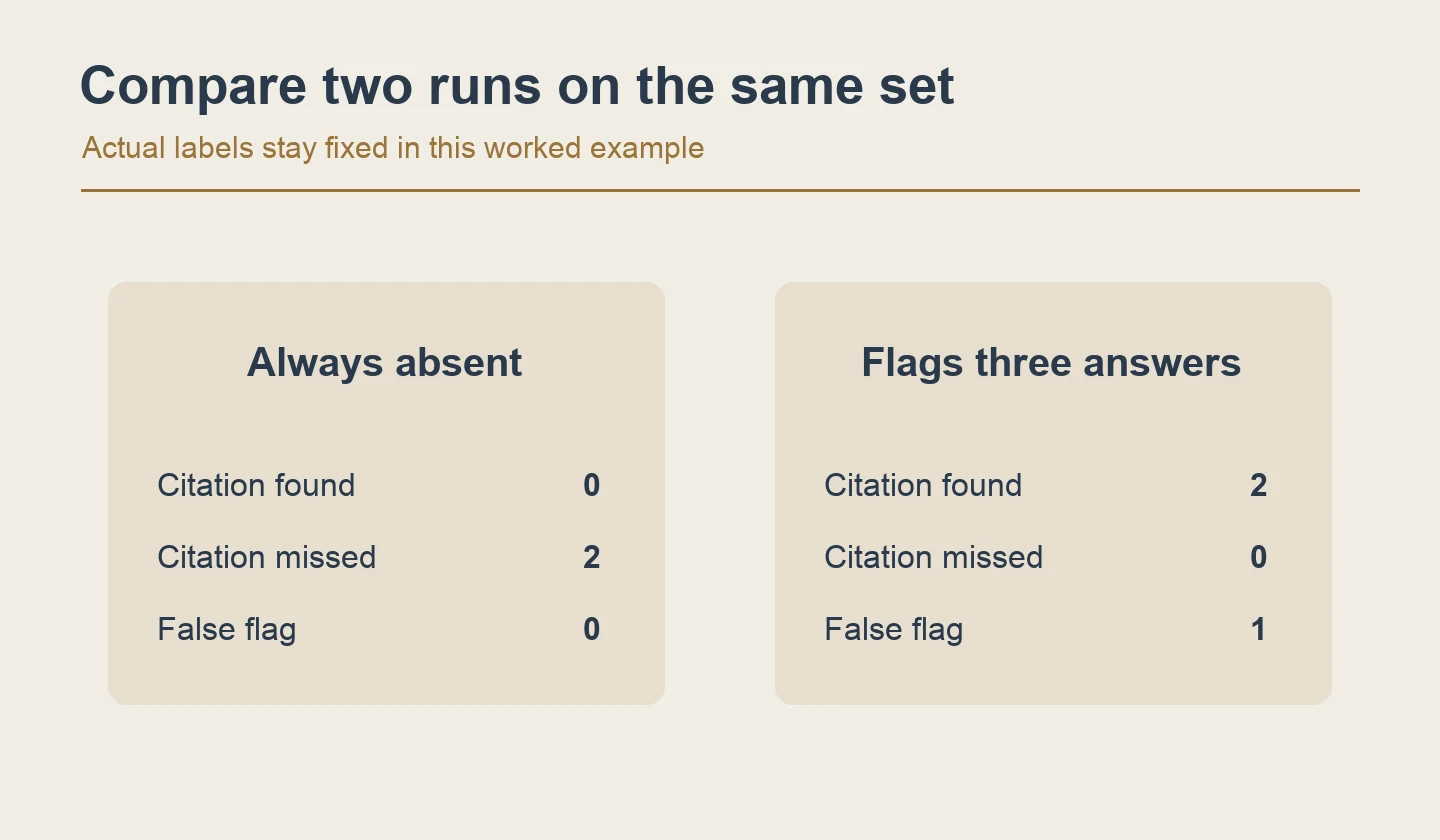
Two predictions on the same ten answers
Always absent
8 of 10 correct. Detects 0 of 2 citations.
Flags three answers
9 of 10 correct. Finds both citations and flags one absence.
Inspect the actual and predicted classes in Confusion matrix documentation.
Sources: Confusion matrix documentation · Precision score documentation
Use the comparison for one narrow decision
To compare another version, keep the evidence set and labeling rules fixed. Save the counts for correct matches, false flags, missed citations and correct absences. A balanced-accuracy summary can average recall for the citation and absence classes, but keep the counts too. With just two positive examples, missing one cuts positive recall by half.
If you still have only a few answers with citations, add a separately labeled set before making a general performance claim. Keep detector accuracy and the site’s share of cited answers as two separate measures.
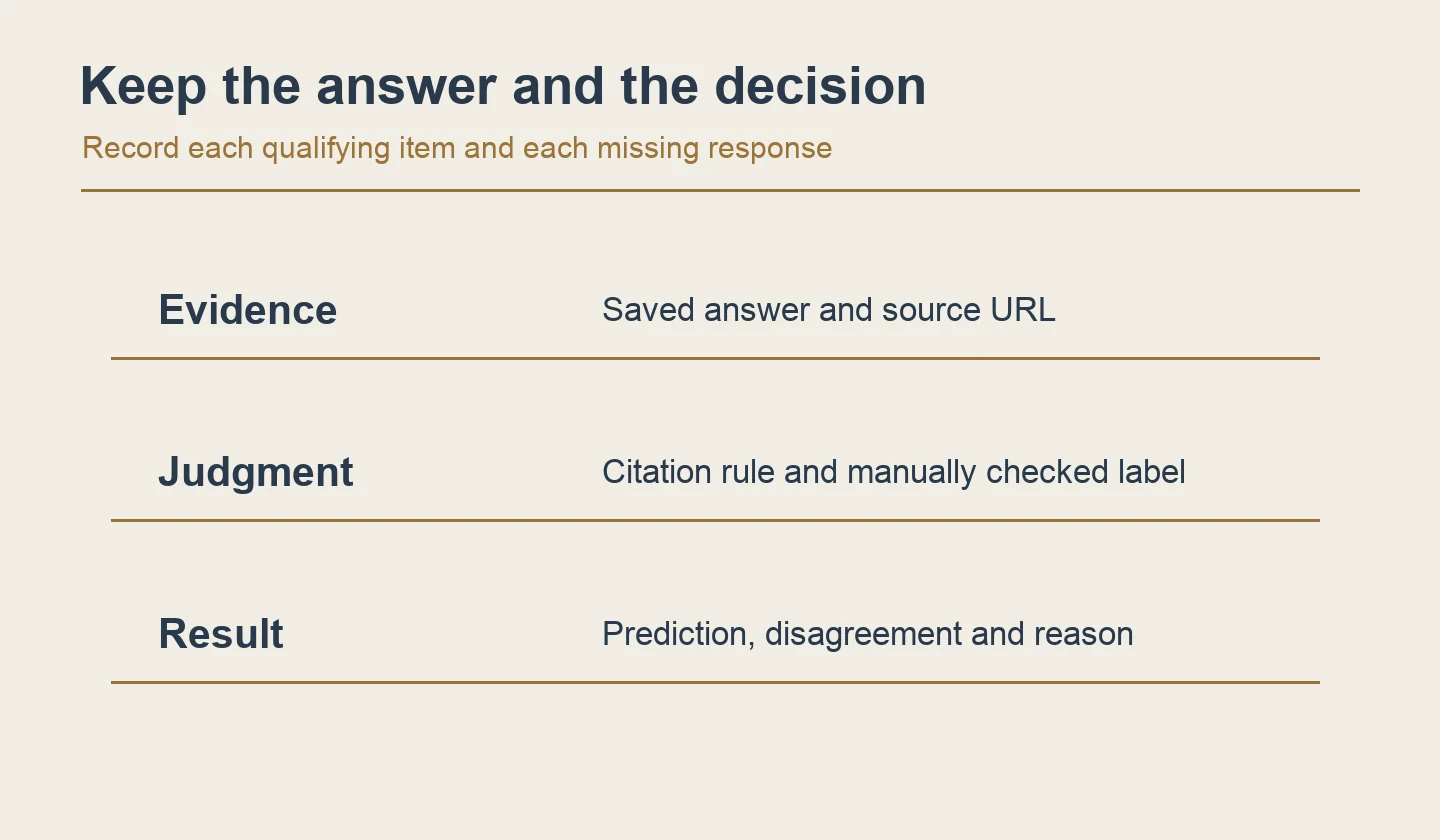
Keep the evaluation reproducible
- Save the expected citation rule and exact host.
- Keep missing answers separate from absences.
- Run the baseline on the same labeled answers.
- Inspect each missed or incorrect flag.
See the balanced-score definition in Balanced accuracy score documentation.
For the related task, see Separate citation and mention evidence.
Sources: Balanced accuracy score documentation · Confusion matrix documentation
Frequently asked questions
Does this score say how often a brand gets cited?
The fixture assesses a detector’s correctness. Brand citation prevalence is a separate count over a defined set of answers.
Why is precision undefined when every prediction is negative?
Precision divides correct positive predictions by all positive predictions. If there are none, the denominator is zero.
Can I count a timed-out answer as absent?
Keep a timeout in the collection record. You cannot judge whether that answer cites a site if the answer was never received.
Is 90% on these ten examples a reliable benchmark?
The ten cases are fictional. To evaluate a real detector, use a larger labeled set and report the sample and counts.
My AI Search ReportKeep failed checks visible
Track coverage before comparing AI test results.
Read how to handle missing answersContinue with a related guide
- Keep failed checks visible
Track coverage before comparing AI test results.
- Separate citation and mention evidence
Write down what qualifies as a link before labeling.
- Review the precision and recall formulas
Check the two denominators directly.
References
- Confusion matrix documentation scikit-learn
- Balanced accuracy score documentation scikit-learn
- Precision score documentation scikit-learn